The Open Quran
Explore Islam through an intelligent tagging system that connects the Qur'an, hadith, and scholarly insights. Tap any tag and instantly discover how Islamic knowledge weaves together — a modern dawah experience designed for curious minds.
“Seeking knowledge is an obligation upon every Muslim.”
— Prophet Muḥammad ﷺ · Ibn Mājah 224, graded Ṣaḥīḥ
We believe that knowledge — especially knowledge this important — should not only be freely available, but easy to find, easy to understand, and easy to explore. Every article, verse, hadith, debate, and answer on this site is tagged and linked together, so clicking a topic like “Prophecy & End Times” or “Comparative Religion” instantly surfaces everything related — no dead ends, no jumping between sites. It is open-source in spirit: built for the public, maintained transparently, and designed so that anyone, anywhere, can learn with confidence.
One Platform, Every Source Connected
Every piece of content is tagged by topic. Click any tag and instantly see every related debate, Q&A, Qur'anic verse, and hadith — no more searching across dozens of sites.
Qur'an Reader
Read all 114 surahs with Arabic text, transliteration, and English translation. Toggle each layer to match your study preference.
Debate Archive
Full transcripts of interfaith debates with color-coded speakers, timestamps, source references, and argument structure analysis.
Q&A Database
Scholarly answers to common questions and objections, each backed by Qur'anic verse citations and authenticated hadith references.
Hadith Collection
Narrations from major collections with authenticity grading, chain of narration, Arabic text, and scholarly commentary.
Articles
Scholarly writings on fiqh, aqeedah, and Islamic life — tagged by topic and cross-referenced with related content.
Topic Tags
Click any tag to see every related resource across all content types. The cross-referencing system makes research fast and comprehensive.
Featured Debates
Key interfaith discussions and scholarly exchanges
 3:07:20
Mohammed Hijab vs David Wood — Trinity or Tawhid?
A full structured debate between Mohammed Hijab and David Wood on the core theological question: Is God's nature best understood through the Islamic concept of Tawhid (absolute oneness) or the Christian doctrine of the Trinity? Hosted by York College MSA in New York.
 1:22:10
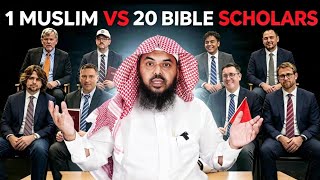
20 Christians vs 1 Muslim — Uthman ibn Farooq at Southern Baptist Theological Seminary
A structured debate between Shaykh Uthman ibn Farooq and twenty students and professors from the Southern Baptist Theological Seminary — the largest Baptist Bible university in America — held in Louisville, Kentucky. The debate rotates through four prompts via a flag-vote elimination mechanism: (1) The Prophet Muhammad is clearly mentioned in the Bible; (2) Jesus is not God according to the Bible; (3) Jesus is a prophet and servant of God; and (4) the Bible is not 100% preserved. Participants include a Conservative Presbyterian, a Biblical Unitarian pastor, Catholic and non-denominational students, an Episcopalian, and others. Key arguments cover Song of Solomon 5:16 (Muhammadim), Isaiah 42 (Kedar, Sal'a, Mushallam), ego imai in Luke and John, divine omniscience and hypostatic union, Acts 3:13, Hebrews 2:7-9, the Johannine Comma, Mark 16:9-20, Matthew-Luke genealogy contradictions, and the manuscript and chain-of-transmission preservation of the Quran.
 1:48:00
Shaykh Uthman vs Captain Tazaryach — Is the Bible the Word of God?
A heated debate between Shaykh Uthman Ibn Farooq (Muslim) and Captain Tazaryach (Hebrew Israelite) on whether the Bible is the preserved Word of God. Shaykh Uthman presents multiple internal contradictions in the Old Testament — including three conflicting accounts of King Saul's death, contradictory ages for King Ahaziah, and irreconcilable genealogies of Jesus in Matthew vs Luke vs 1 Chronicles. The debate concludes with an extensive discussion on underage marriage in biblical tradition, including Rashi's commentary on Rebekah's age and early Christian sources on Mary's age at marriage.
Common Questions
Frequently asked questions and objections addressed
All religions basically teach their followers to do good deeds. Why should a person only follow Islam?
While many religions share common moral teachings, the critical difference lies in theology and the concept of God. All major religions, in their original form, taught the worship of One God (monotheism). Over time, human interpolations introduced polytheism, idolatry, and the deification of prophets and saints. Islam offers the purest, unaltered monotheism and a preserved scripture — the Qur'an remains unchanged since its revelation, unlike other religious texts which have undergone modifications.
Is fighting and warfare prescribed only in Islam, or do other religions also permit it?
Fighting for a just cause has been prescribed in virtually all major world religions, not only Islam. The Bible commands killing in multiple passages (Ezekiel 9:5, Exodus 32:27-28). Jesus told his followers to buy swords (Luke 22:36). The Hindu Bhagavad Gita contains 18 chapters centered on Lord Krishna commanding Arjuna to fight and kill his own relatives in battle. The Qur'an commands justice even against one's own self and family.
Does Islam support violence against non-Muslims?
No. The Qur'an explicitly states 'there is no compulsion in religion' (2:256) and permits fighting only in self-defense. Verses about warfare were revealed in specific historical contexts of persecution and self-defense, not as blanket commands.
Does Jihad mean 'Holy War'?
No. Many people translate 'Jihad' as 'Holy War,' but the Arabic words for 'holy war' — 'Harbum Muqaddasah' — appear nowhere in the Qur'an or any authentic Hadith. The term 'holy war' was first coined by European orientalists to describe the Crusades and was later misapplied to Islam. The Arabic word 'Jihad' comes from 'jahada,' meaning to strive or struggle.
Does the Qur'an tell Muslims to kill non-Muslims?
No. Critics frequently quote Qur'an 9:5 out of context — 'kill the polytheists wherever you find them' — to claim this. However, this verse was revealed in the context of a specific peace treaty that was unilaterally broken by the Makkan polytheists. The very next verse (9:6) commands Muslims to grant protection to any enemy who seeks it and escort them to a place of safety. Reading any text out of context distorts its meaning.
Explore Topics
Every resource is tagged by topic. Click a tag to see all related debates, Q&A, verses, and hadith in one place.