Tawhid
41 items across 6 content types
Debates (3)
 3:07:20
Mohammed Hijab vs David Wood — Trinity or Tawhid?
A full structured debate between Mohammed Hijab and David Wood on the core theological question: Is God's nature best understood through the Islamic concept of Tawhid (absolute oneness) or the Christian doctrine of the Trinity? Hosted by York College MSA in New York.
 2:54:50
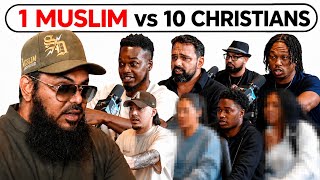
Muslim Faces 10 — Jesus Is Not Almighty God According to the Bible
A structured summary of a long debate about whether Jesus is Almighty God according to the Bible, followed by a second prompt about whether Muhammad is clearly mentioned in the Bible. The discussion repeatedly turns on Bible verses about Jesus and God, Qur'anic names and titles, shirk, takfir, translation differences, Psalm 83:18, Jeremiah 23:5-6, Revelation 1 and 22, manuscript corruption, and Qur'anic authority over previous scripture.
 1:22:10
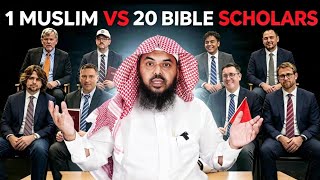
20 Christians vs 1 Muslim — Uthman ibn Farooq at Southern Baptist Theological Seminary
A structured debate between Shaykh Uthman ibn Farooq and twenty students and professors from the Southern Baptist Theological Seminary — the largest Baptist Bible university in America — held in Louisville, Kentucky. The debate rotates through four prompts via a flag-vote elimination mechanism: (1) The Prophet Muhammad is clearly mentioned in the Bible; (2) Jesus is not God according to the Bible; (3) Jesus is a prophet and servant of God; and (4) the Bible is not 100% preserved. Participants include a Conservative Presbyterian, a Biblical Unitarian pastor, Catholic and non-denominational students, an Episcopalian, and others. Key arguments cover Song of Solomon 5:16 (Muhammadim), Isaiah 42 (Kedar, Sal'a, Mushallam), ego imai in Luke and John, divine omniscience and hypostatic union, Acts 3:13, Hebrews 2:7-9, the Johannine Comma, Mark 16:9-20, Matthew-Luke genealogy contradictions, and the manuscript and chain-of-transmission preservation of the Quran.
Debate Excerpts (14)
Individual points from debates discussing this topic
“What is the core thesis of the Islamic position in this debate?”
The Islamic understanding of God — Tawhid — is that God is absolutely one, without partners, persons, or divisions. This is the most internally consistent and historically defensible monotheism. The Trinity, by contrast, was a later theological development that cannot be justified from the Old Testament, was not clearly taught by Jesus, and creates logical contradictions.
“How does the Old Testament support absolute monotheism?”
The Shema (Deuteronomy 6:4) declares 'Hear O Israel, the Lord our God, the Lord is one.' Exodus 20:3 commands 'You shall have no other gods before me.' Isaiah 43:11 states 'I, even I, am the Lord, and besides me there is no saviour.' Isaiah 44:6 says 'I am the first and I am the last; besides me there is no God.' These passages use singular pronouns and emphatic language that leaves no room for a multi-personal God.
“Does the Arabic of Surah 33:56 really mean Allah 'prays'?”
The verb 'salla ala' has a completely different meaning from 'salla li-llah.' When used with 'ala' (upon), it means to send blessings, commend, or extol — not to worship, pray, or supplicate. Arabic is a nuanced language: 'salla ala an-Nabi' means 'God sends blessings upon the Prophet,' not 'God prays to someone for the Prophet.' This is a deliberate equivocation by Wood that ignores basic Arabic morphology.
“What about God's 'face' and 'parts' in the Quran?”
The 'face' (wajh) of God in Arabic is understood as referring to God's essence or self — 'wajh' also means 'direction,' 'aspect,' or 'being.' The ayah 'everything will perish except His face' means 'everything will perish except Him.' This is standard Arabic usage, not anthropomorphism. The Athari, Ash'ari, and Maturidi schools all address this: divine attributes are affirmed 'without how' (bila kayf) — they are not physical parts, and the Arabic does not require that reading.
“Is the Quran a 'second divine person' like the Christian Logos?”
The Quran is an attribute of God (kalaam Allah — God's speech), not a separate entity or person. An attribute is not a person. God's knowledge is eternal, God's power is eternal — but no one calls God's power a 'second god.' The hadith about the Quran interceding uses metaphorical language about the Day of Judgement — just as good deeds 'intercede' for a person. The Christian Logos doctrine says the Word is a person who became incarnate — the Quran is not a person and did not become incarnate.
“What about 'Umm al-Kitab' and 'Kalimatullah' (Jesus as Word of God)?”
'Umm' in Arabic does not only mean 'mother' — it means 'origin,' 'source,' 'foundation,' or 'essence.' 'Umm al-Qura' (Makkah) means 'the foundational city,' not that Makkah has a literal mother. 'Umm al-Kitab' means the 'source/foundation of the Book' — the preserved archetype. As for Jesus being 'Kalimatullah': this means he was created by God's command ('Be!' — kun fayakun). He is a word from God in the sense that he came into being by God's direct creative word, not that he is an eternal divine person.
“Does Hijab further clarify the 'salah' linguistics?”
The Arabic root S-L-W has multiple meanings depending on form and preposition. 'Salla ala' means to send blessings or commend — it is used for humans too: we 'nusalli ala an-Nabi' (send blessings upon the Prophet). 'Salla li-llah' means to pray to God, to worship. No Arabic speaker confuses these. The word 'salah' itself derives from the root 'sila' (connection), meaning prayer is a connection to God. Wood's argument relies entirely on English conflation — it does not work in Arabic.
“What about intercession (shafa'ah) — does it imply a 'second person'?”
Intercession in Islam only happens 'with God's permission' — Ayat al-Kursi (2:255) explicitly states 'Who is it that can intercede with Him except by His permission?' This is fundamentally different from the Christian concept where the Son independently mediates. In Islam, intercession is a divine gift, not an autonomous function. Prophets, the Quran, good deeds, and fasting all 'intercede' — none of them are second divine persons.
The Islamic position is not that Ebionites were perfect Muslims — it's that their monotheism was closer to the truth than later Trinitarian theology. Islam came to correct all previous distortions. The Ebionites are evidence that the earliest Jesus followers were monotheists who did not worship Jesus — the deification was a later innovation. That the details of Ebionite theology differ from Islam is irrelevant; the point is about the trajectory from monotheism to Trinity being a theological drift.
“Where does the word 'Tawhid' come from, and why is it the purest expression of monotheism?”
Tawhid derives from the Arabic root W-H-D, meaning 'to make one' or 'to unify.' It is the active assertion that God is one — not merely that there is one God, but that God's oneness excludes all division, composition, partnership, or plurality. This is the message of every prophet: Abraham, Moses, Jesus, Muhammad. The Shema, the first commandment, and the Shahada all express this same truth: there is no God but the One God.
Tawhid is the simplest, most consistent, and most historically continuous form of monotheism. It was the message of Abraham, Moses, Jesus, and Muhammad. God is one: without parts, without persons, without partners. He does not need a son to save humanity — He forgives directly. He does not need to become human to understand human suffering — He is All-Knowing and All-Merciful. He does not need three persons to have relational attributes — He is sufficient in Himself.
“How is the names-and-attributes question answered?”
The reply is that some sifat are unique to Allah, such as Ar-Rahman, while others can be used for creation in a qualified sense, such as Rahim or loving. The argument is that there is a difference between sharing a word in a restricted context and applying Allah's unique attributes to a creature in a way that rivals Him.
“How does Jesus being sent by God negate Jesus being God himself?”
Uthman asks: so you are saying God sent Jesus? The student says yes. Uthman responds: then that negates him being God, because he is sent by God. If God himself came, he would not say he is a messenger of God — he would say I am God. When you say God sent Jesus, you are saying a sender (God) dispatched a recipient (Jesus). These are two distinct entities. God sent God is a statement that only makes sense if you already believe in two separate divine persons — which is a Trinitarian presupposition, not a biblical inference. The student transitions to asking about Islamic theology of creation rather than pressing the point.
“Can the messenger of God be God himself? What does the messenger relationship imply?”
Uthman argues that being the vehicle of God, the message of God, and the messenger of God does not make you God — it makes you the most excellent of God's messengers. Moses was a messenger of God, the vehicle for God's revelation, and the channel of the message — but Moses was not God. If God himself came to earth, he would not be described as a messenger OF God. He would simply be God. The word of belongs to a possessive relationship: you can only be the messenger of someone else. A being cannot simultaneously be God and be a messenger sent from God — these are logically exclusive categories. Jesus being the most complete messenger of God in the Christian framework still places him as a distinct being from God.
Questions (9)
All religions basically teach their followers to do good deeds. Why should a person only follow Islam?
While many religions share common moral teachings, the critical difference lies in theology and the concept of God. All major religions, in their original form, taught the worship of One God (monotheism). Over time, human interpolations introduced polytheism, idolatry, and the deification of prophets and saints. Islam offers the purest, unaltered monotheism and a preserved scripture — the Qur'an remains unchanged since its revelation, unlike other religious texts which have undergone modifications.
How does Islam view sin, forgiveness, and salvation?
Islam teaches that every person is born sinless in a natural state of purity (fitrah). There is no concept of original sin. When a person sins, they can repent directly to God without any intermediary — no priest, no confession booth, no blood sacrifice is needed. God's mercy encompasses all things, and sincere repentance is always accepted.
Is Jesus God, the Son of God, or a Prophet?
According to both the Bible and the Qur'an, Jesus was a mighty Prophet and Messenger of God — not God Himself nor literally God's son. The Bible records that Jesus prayed to God, called God 'greater than me,' and declared the greatest commandment to be 'The Lord our God, the Lord is one.' The Qur'an honors Jesus as the Messiah, born miraculously, but worships God alone.
What does Islam say about Jesus (Isa)?
Islam reveres Jesus (Isa ibn Maryam) as one of the greatest prophets and the Messiah. Muslims believe in his virgin birth, his miracles, and his return before the Day of Judgment, but do not accept his divinity or crucifixion as understood in Christianity.
What do the Bible and the Qur'an agree on?
Far more than most people realise. The Bible and the Qur'an both declare that God is absolutely one (Deuteronomy 6:4; Mark 12:29; Qur'an 112:1), both command sincere private prayer (Matthew 6:5-6; Qur'an 2:45), both record fasting as an act of worship (Matthew 4:2; Joel 2:12; Qur'an 2:183), both prohibit pork (Leviticus 11:7-8; Qur'an 2:173) and intoxicants (Proverbs 20:1; Qur'an 5:90), both call for modesty in dress (1 Timothy 2:9; Qur'an 24:31), and both foreground care for orphans and the poor as markers of authentic faith (James 1:27; Qur'an 2:177). Even Jesus' posture in prayer — falling on his face (Matthew 26:39) — is the same prostration performed by every Muslim five times daily.
What is Original Sin, and does Islam reject it?
Original Sin is the Christian doctrine — most fully developed by Augustine in the 4th century CE — that Adam's transgression in the Garden of Eden passed a state of inherited guilt and moral corruption to every human being, requiring Christ's atoning sacrifice for redemption. Islam firmly rejects this, teaching instead that every human is born in a state of pure fitrah (natural purity), that no soul can bear the sin of another, and that God forgives through sincere repentance alone — without any blood sacrifice. The Hebrew Bible's own prophets — Ezekiel, Jeremiah, Isaiah, and Micah — all explicitly affirm individual accountability and deny that children bear the guilt of their parents.
What is the concept of God in Islam?
Islam teaches pure, uncompromising monotheism (Tawhid). God (Allah) is One, Unique, All-Powerful, Most High, and Perfect. He has no partners, equals, rivals, sons, daughters, or family. He does not do ungodly acts, does not have human limitations, and nothing in creation resembles Him. This clear, uncomplicated concept of God is considered the foundation of the entire faith.
What was the original message that Jesus preached?
Jesus preached the same message as every Prophet before him: worship the One True God alone. When asked about the greatest commandment, Jesus replied: 'The Lord our God, the Lord is one' (Mark 12:29) — a direct quote from the Old Testament. He never claimed divinity or asked people to worship him. Islam teaches that Jesus confirmed the message of Moses and the earlier Prophets.
When Islam is against idol worship, why do Muslims worship and bow down to the Ka'bah in their prayer?
Muslims do not worship the Ka'bah. It serves as a Qiblah — a unified direction for prayer. Just as a direction is not an object of worship, the Ka'bah simply unifies the 2 billion Muslims worldwide to face one point during prayer, symbolizing the unity of the Muslim community and the Oneness of God.
Articles (6)
Common Ground: Bible Teachings That Align with the Qur'an and Islamic Practice
From monotheism to fasting, modesty to caring for orphans — the parallels between the Qur'an and the Bible are more extensive than most people realise.
TheOpenQuran Research
One of the most effective approaches in interfaith dialogue is to build on shared foundations. Muslims and Christians — and Muslims and Jews — share far more in common than their differences suggest. This article explores specific Bible verses that directly parallel Quranic teachings: the same insistence on one God, the same call to sincere private prayer, the same practice of fasting, the same prohibition of pork and alcohol, the same call to modesty, the same emphasis on caring for orphans and the poor. The Bible does not merely tolerate these Islamic practices — it commands them.
Did Jesus Die for Our Sins? A Biblical and Qur'anic Response
Examining the doctrine of atonement — what the Bible actually says about sin, sacrifice, and forgiveness
Sheikh Ahmad Deedat
The doctrine of atonement — that Jesus died to pay for humanity's inherited sin — is the cornerstone of mainstream Christianity. Yet the Bible itself, in its most direct prophetic statements, teaches the opposite: that sin is personal and non-transferable, that God does not require blood sacrifice to forgive, and that the path to salvation is repentance and righteous action. This article examines the doctrine of Original Sin and its foundation in the sacrifice narrative, the Islamic understanding of Jesus as 'Word of God' and 'Spirit from God,' and what Luke 24 reveals when Jesus himself corrects the misconception that he is a resurrected spiritual being.
Jesus in His Own Words: Bible Verses That Challenge the Claim of Divinity
A systematic look at what the Bible records Jesus saying about himself, God, and the limits of his knowledge and power.
TheOpenQuran Research
Muslims, Christians, and Jews all hold Jesus in esteem — but they disagree profoundly about his nature. This article does not rely on the Qur'an alone. It examines what the Bible itself records Jesus saying about God, about his own limitations, about his need to pray, and about his role as a sent messenger. The evidence — drawn from Matthew, Mark, Luke, John, Acts, Hebrews, and the epistles — presents a consistent portrait of a man who was subordinate to God, had limited knowledge, experienced human needs, and directed worship to the Father. This article presents that evidence systematically and acknowledges the Christian interpretive response at each point.
15 Common Misconceptions About Islam — Addressed and Clarified
A comprehensive response to the most widespread myths surrounding Islam, Muslims, and the Qur'an
Compiled from Islamic Scholarship
From headlines linking Islam to extremism to centuries-old myths about the nature of Allah and the status of women, misconceptions about Islam are among the most pervasive in the modern world. This article systematically addresses fifteen of the most common misunderstandings — drawing from the Qur'an, the authenticated Sunnah, and the findings of non-Muslim historians and scholars — to offer a clear, evidence-based clarification for any sincere seeker of truth.
Original Sin: What the Bible and Qur'an Actually Say
Does the Bible support the doctrine that all humans inherit Adam's guilt? The answer may surprise you.
TheOpenQuran Research
One of Christianity's most distinctive doctrines — Original Sin — holds that Adam's transgression in the Garden of Eden passed a state of inherent guilt and corruption to every human being, requiring Christ's sacrifice for redemption. This article examines that doctrine through two lenses: first, what the Qur'an teaches about human nature (fitrah and personal accountability); and second — crucially — what the Bible's own prophets say about inherited guilt, individual responsibility, and how God forgives. The biblical evidence against inherited sin is direct, extensive, and largely overlooked.
Raising Children in Islam: Foundations and Practical Tips
Core responsibilities every Muslim parent must fulfil — with fifteen actionable steps for today's challenges
Compiled from Jamiatul Ulama KZN
This comprehensive guide draws together the foundational Islamic responsibilities of parenthood — from instilling Tawheed and the rights of Allah, to teaching halal conduct, nurturing role models, and establishing a wholesome home environment — and pairs them with fifteen practical, actionable tips for Muslim parents navigating the challenges of modern life. Whether you are a new parent or seeking to refocus your approach, this article offers both the 'why' and the 'how' of raising children the Islamic way.
Qur'an Verses (4)
قُولُوٓا۟ ءَامَنَّا بِٱللَّهِ وَمَآ أُنزِلَ إِلَيْنَا وَمَآ أُنزِلَ إِلَىٰٓ إِبْرَٰهِـۧمَ وَإِسْمَـٰعِيلَ وَإِسْحَـٰقَ وَيَعْقُوبَ وَٱلْأَسْبَاطِ وَمَآ أُوتِىَ مُوسَىٰ وَعِيسَىٰ وَمَآ أُوتِىَ ٱلنَّبِيُّونَ مِن رَّبِّهِمْ لَا نُفَرِّقُ بَيْنَ أَحَدٍ مِّنْهُمْ وَنَحْنُ لَهُۥ مُسْلِمُونَ
Qulu amanna billahi wa ma unzila ilayna wa ma unzila ila Ibrahima wa Isma'ila wa Ishaqa wa Ya'quba wal-Asbati wa ma utiya Musa wa 'Isa wa ma utiya an-Nabiyyuna min Rabbihim la nufarriqu bayna ahadin minhum wa nahnu lahu Muslimun
“Say, 'We have believed in Allah and what has been revealed to us and what has been revealed to Abraham and Ishmael and Isaac and Jacob and the Descendants, and what was given to Moses and Jesus and what was given to the prophets from their Lord. We make no distinction between any of them, and we are Muslims in submission to Him.'”
ٱللَّهُ لَآ إِلَـٰهَ إِلَّا هُوَ ٱلْحَىُّ ٱلْقَيُّومُ ۚ لَا تَأْخُذُهُۥ سِنَةٌ وَلَا نَوْمٌ ۚ لَّهُۥ مَا فِى ٱلسَّمَـٰوَٰتِ وَمَا فِى ٱلْأَرْضِ ۗ مَن ذَا ٱلَّذِى يَشْفَعُ عِندَهُۥٓ إِلَّا بِإِذْنِهِۦ ۚ يَعْلَمُ مَا بَيْنَ أَيْدِيهِمْ وَمَا خَلْفَهُمْ ۖ وَلَا يُحِيطُونَ بِشَىْءٍ مِّنْ عِلْمِهِۦٓ إِلَّا بِمَا شَآءَ ۚ وَسِعَ كُرْسِيُّهُ ٱلسَّمَـٰوَٰتِ وَٱلْأَرْضَ ۖ وَلَا يَـُٔودُهُۥ حِفْظُهُمَا ۚ وَهُوَ ٱلْعَلِىُّ ٱلْعَظِيمُ
Allahu la ilaha illa Huwa al-Hayyu al-Qayyum. La ta'khudhuhu sinatun wa la nawm. Lahu ma fis-samawati wa ma fil-ard. Man dhal-ladhi yashfa'u 'indahu illa bi idhnihi. Ya'lamu ma bayna aydihim wa ma khalfahum. Wa la yuhituna bishay'in min 'ilmihi illa bima sha'. Wasi'a kursiyyuhus-samawati wal-ard. Wa la ya'uduhu hifzuhuma. Wa Huwa al-'Aliyyu al-'Azim
“Allah — there is no deity except Him, the Ever-Living, the Self-Sustaining. Neither drowsiness overtakes Him nor sleep. To Him belongs whatever is in the heavens and whatever is on the earth. Who is it that can intercede with Him except by His permission? He knows what is before them and what will be after them, and they encompass not a thing of His knowledge except for what He wills. His Kursi extends over the heavens and the earth, and their preservation tires Him not. And He is the Most High, the Most Great.”
وَمَا خَلَقْتُ ٱلْجِنَّ وَٱلْإِنسَ إِلَّا لِيَعْبُدُونِ
Wa ma khalaqtul-jinna wal-insa illa liya'budun
“And I did not create the jinn and mankind except to worship Me.”
قُلْ هُوَ ٱللَّهُ أَحَدٌ ﴿١﴾ ٱللَّهُ ٱلصَّمَدُ ﴿٢﴾ لَمْ يَلِدْ وَلَمْ يُولَدْ ﴿٣﴾ وَلَمْ يَكُن لَّهُۥ كُفُوًا أَحَدٌ
Qul Huwa Allahu Ahad. Allahu as-Samad. Lam yalid wa lam yulad. Wa lam yakun lahu kufuwan ahad
“Say, 'He is Allah, the One. Allah, the Eternal Refuge. He neither begets nor is born, nor is there to Him any equivalent.'”
Hadith (5)
أَنْ تَعْبُدَ اللَّهَ كَأَنَّكَ تَرَاهُ فَإِنْ لَمْ تَكُنْ تَرَاهُ فَإِنَّهُ يَرَاكَ
An ta'bud Allaha ka'annaka tarahu, fa in lam takun tarahu fa innahu yarak
Narrated by Umar ibn al-Khattab
بُنِيَ الإِسْلاَمُ عَلَى خَمْسٍ شَهَادَةِ أَنْ لاَ إِلَهَ إِلاَّ اللَّهُ وَأَنَّ مُحَمَّدًا رَسُولُ اللَّهِ وَإِقَامِ الصَّلاَةِ وَإِيتَاءِ الزَّكَاةِ وَالْحَجِّ وَصَوْمِ رَمَضَانَ
Buniya al-Islamu 'ala khamsin: shahadati an la ilaha illallah wa anna Muhammadan Rasulullah, wa iqamis-salah, wa ita'iz-zakah, wal-hajj, wa sawmi Ramadan
Narrated by Abdullah ibn Umar
الإِيمَانُ بِضْعٌ وَسَبْعُونَ أَوْ بِضْعٌ وَسِتُّونَ شُعْبَةً فَأَفْضَلُهَا قَوْلُ لاَ إِلَهَ إِلاَّ اللَّهُ وَأَدْنَاهَا إِمَاطَةُ الأَذَى عَنِ الطَّرِيقِ وَالْحَيَاءُ شُعْبَةٌ مِنَ الإِيمَانِ
Al-imanu bid'un wa sab'una aw bid'un wa sittuna shu'bah, fa afdaluha qawlu la ilaha illallah, wa adnaha imatat al-adha 'an at-tariq, wal-haya'u shu'batun min al-iman
Narrated by Abu Hurairah
لاَ تُطْرُونِي كَمَا أَطْرَتِ النَّصَارَى ابْنَ مَرْيَمَ، فَإِنَّمَا أَنَا عَبْدُهُ، فَقُولُوا عَبْدُ اللَّهِ وَرَسُولُهُ
La tutruni kama atrat an-Nasara ibna Maryam, fa innama ana 'abduhu, fa qulu 'Abdullah wa Rasuluhu
Narrated by Umar ibn al-Khattab
مَنْ شَهِدَ أَنْ لاَ إِلَهَ إِلاَّ اللَّهُ وَحْدَهُ لاَ شَرِيكَ لَهُ، وَأَنَّ مُحَمَّدًا عَبْدُهُ وَرَسُولُهُ، وَأَنَّ عِيسَى عَبْدُ اللَّهِ وَرَسُولُهُ، وَكَلِمَتُهُ أَلْقَاهَا إِلَى مَرْيَمَ وَرُوحٌ مِنْهُ
Man shahida an la ilaha illallahu wahdahu la sharika lahu, wa anna Muhammadan 'abduhu wa rasuluhu, wa anna 'Isa 'abdullahi wa rasuluhu, wa kalimatuhu alqaha ila Maryam wa ruhun minhu
Narrated by Ubadah ibn as-Samit