Textual Preservation
38 items across 5 content types
Debates (2)
 1:22:10
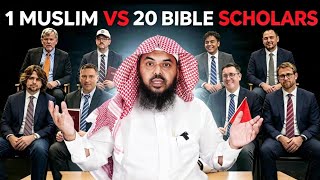
20 Christians vs 1 Muslim — Uthman ibn Farooq at Southern Baptist Theological Seminary
A structured debate between Shaykh Uthman ibn Farooq and twenty students and professors from the Southern Baptist Theological Seminary — the largest Baptist Bible university in America — held in Louisville, Kentucky. The debate rotates through four prompts via a flag-vote elimination mechanism: (1) The Prophet Muhammad is clearly mentioned in the Bible; (2) Jesus is not God according to the Bible; (3) Jesus is a prophet and servant of God; and (4) the Bible is not 100% preserved. Participants include a Conservative Presbyterian, a Biblical Unitarian pastor, Catholic and non-denominational students, an Episcopalian, and others. Key arguments cover Song of Solomon 5:16 (Muhammadim), Isaiah 42 (Kedar, Sal'a, Mushallam), ego imai in Luke and John, divine omniscience and hypostatic union, Acts 3:13, Hebrews 2:7-9, the Johannine Comma, Mark 16:9-20, Matthew-Luke genealogy contradictions, and the manuscript and chain-of-transmission preservation of the Quran.
 1:48:00
Shaykh Uthman vs Captain Tazaryach — Is the Bible the Word of God?
A heated debate between Shaykh Uthman Ibn Farooq (Muslim) and Captain Tazaryach (Hebrew Israelite) on whether the Bible is the preserved Word of God. Shaykh Uthman presents multiple internal contradictions in the Old Testament — including three conflicting accounts of King Saul's death, contradictory ages for King Ahaziah, and irreconcilable genealogies of Jesus in Matthew vs Luke vs 1 Chronicles. The debate concludes with an extensive discussion on underage marriage in biblical tradition, including Rashi's commentary on Rebekah's age and early Christian sources on Mary's age at marriage.
Debate Excerpts (29)
Individual points from debates discussing this topic
“If the Quran is in Arabic, doesn't that make Islam inaccessible to non-Arabic speakers?”
The Quran was revealed in Arabic because that was the language of the Prophet Muhammad and his community. But Islam is for all humanity: translations, tafsir (exegesis), and scholarly commentary make the Quran accessible in every major language. The original Arabic is preserved for precision — just as legal and scientific texts have authoritative original-language versions. A non-Arabic speaker can understand the Quran's message fully through qualified translation, but having the original ensures textual integrity that no biblical manuscript tradition can match.
The Uthmanic codification did not 'burn variants' — it standardised the written manuscripts to match the oral tradition that was already uniform. The companions' codices differed in personal notations and arrangement, not in content. The oral chain of transmission (mutawatir) — thousands of memorisers in each generation — is the primary preservation method, not manuscripts. This is categorically different from the Bible's manuscript tradition, which has hundreds of thousands of textual variants between manuscripts and no unbroken oral chain.
“What does Numbers 23:19 say about the divine nature and lying?”
When the topic of whether God can lie comes up, Robin challenges the claim by invoking Job: "Somebody said that God never lied, and I thought immediately about Job. God told Job some whoppers just to check him out." Uthman acknowledges the exchange and responds with Numbers 23:19: God is not a man that he should lie. This is a direct biblical statement distinguishing the divine nature from human fallibility. Robin says she does not take the Bible literally anyway, so the verse carries limited force for her. Uthman uses it to establish the broader point: if there are things God categorically does not do (such as lie), then omniscience is another such essential attribute — and a being that does not know something at any moment cannot be God.
“What is the fourth prompt about biblical preservation?”
Uthman announces the fourth prompt: I do not believe the Bible is one hundred percent preserved words of God. I believe there are many instances where you will find clear contradictions that were made by scribal errors and others that were inserted by different people over time. This prompt sets up the final stretch of debate where Uthman presents specific documented examples of additions, fabrications, and contradictions acknowledged by Christian biblical scholars themselves.
“How does the Quran function as the Muhayman over the Bible?”
Uthman explains the Islamic concept: the Quran is described as the Muhayman — the guardian, the criterion, and the judge over previous scriptures. He uses the analogy of two rulers: one whose markings are reliable and one whose markings are questionable. You would not throw the imperfect ruler away — you would check it against the gold standard ruler to find where it is right and where it has deviated. Whatever in the Bible aligns with the Quran, Uthman accepts. Whatever contradicts the Quran — like David committing adultery with Bathsheba, killing her husband, or Lot getting drunk and sleeping with his daughters — Uthman rejects as human additions, because these actions are incompatible with the character of a righteous prophet of God.
“What does the Quran's language principle show about the New Testament's origin?”
Uthman cites the Quranic principle: We did not send a messenger except in the language of his people. Jesus spoke Aramaic — that is agreed by scholars. Yet the earliest manuscripts of the New Testament are in Koine Greek. There are no Aramaic originals of the four Gospels. The Gospels as we have them are already translations (or at best transliterations) of what Jesus said — and as such they are removed by at least one step from the words Jesus himself spoke. This contrasts with the Quran, which is in Arabic as the Prophet Muhammad, peace be upon him, delivered it.
“What specific additions does the NET Bible document that are not original to the manuscripts?”
Uthman presents the NET Bible — translated by twenty-five top biblical scholars — and shows specific textual footnotes. In Matthew, there is a passage about prayer and fasting that the NET footnotes state is not found in the earliest manuscripts — it was added later and is almost certainly not original. In Mark 16:9-20, the longer ending of Mark — describing the resurrection appearances and signs of believers — is documented as not appearing in any early manuscripts. The NET note states this longer ending was almost certainly not original and was added by a later copyist. Metzger's work on textual criticism confirms these additions.
“What is the 1 John 5:7 Johannine Comma and when was it added to the Bible?”
1 John 5:7 is the clearest Trinitarian verse in the Bible: in heaven, the Father, the Word, and the Holy Spirit, and these three are one. This is the Johannine Comma. Uthman notes that when he was attending church, this was the verse consistently cited as the most explicit proof of the Trinity. But if you look at the textual research, this verse does not appear in any manuscript until the fourteenth century. It is absent from all early Greek manuscripts, from all early church citations, and from the writings of the early church fathers — even those who were arguing extensively for Trinitarian doctrine and who would surely have used it if it existed. The scholarly conclusion is that the Johannine Comma was fabricated and inserted into the text to support a theology that was already held.
“What do the Matthew and Luke genealogy contradictions reveal about the Bible as the word of God?”
Uthman shows a written comparison of the genealogies side by side. Matthew 1:16 says Jacob was the father of Joseph, the husband of Mary. Luke 3:23 says Joseph was the son of Heli. Two different fathers for Joseph — Jacob versus Heli. Furthermore, from David onward, Matthew traces the line through Solomon (David's son) while Luke traces it through Nathan (a different son of David). These two lines diverge completely for dozens of generations. This is a credo issue: Jesus's connection to King David through the lineage of Joseph was essential to establishing him as the Messiah in Jewish tradition. If the genealogies contradict, the Messianic credential itself is in dispute. The MacArthur Study Bible acknowledges this as a copyist error.
“How is the Quran preserved differently from the Bible, and what is the manuscript evidence?”
Uthman presents a book of scanned manuscripts from the time of the Prophet, peace be upon him, to the present generation. The manuscripts show letter by letter, word by word, the same text — identical across fourteen centuries. Unlike the Bible, which has no manuscripts from the time of Jesus (even credit-card-size scraps date to 70-90 AD, and the earliest semi-complete codices are third or fourth century), the Quran has documented manuscript evidence from the first generation. Furthermore, the methods of recitation — including even the precise pronunciation and elongation of individual letters — are proven through continuous chains of transmission (isnad) going back to the Prophet himself.
“What does Codex Sinaiticus reveal about the formation of the biblical canon?”
Uthman notes that the Codex Sinaiticus — regarded as the first semi-complete Bible, dated to the fourth century — contains books that are not in the modern biblical canon. This means that what counts as the Bible was still being determined in the fourth century, and some of the books that were included in the earliest complete manuscript are no longer considered scripture. This is further evidence that the Bible as it exists today is not the same text that was recognized as authoritative in the earliest centuries of Christianity.
“What does the NET Bible document about Mark 16:9-20 and Matthew additions?”
Uthman shows the NET Bible (twenty-five top biblical scholars) and reads directly from the footnotes. In Matthew, a verse about prayer and fasting is noted as not appearing in the earliest manuscripts — it was added later and is almost certainly not original. In Mark 16:9-20 — the longer ending of Mark, which contains resurrection appearances and the signs of believers including handling snakes and speaking in tongues — the NET Bible note states this passage does not appear in any early manuscript of Mark and was almost certainly not part of the original text. Metzger's textual criticism work confirms these findings. These are not marginal issues: the Mark 16 passage is cited regularly in charismatic and Pentecostal contexts.
“What is the 1 John 5:7 Johannine Comma and why is it a credo-level fabrication?”
1 John 5:7 — in heaven, the Father, the Word, and the Holy Spirit, and these three are one — is the clearest and most explicit Trinitarian verse in the Bible. It is the verse churches use to directly prove the Trinity. Uthman shows that looking at the actual manuscript research, this verse does not appear in any manuscript until the fourteenth century. It is absent from all early Greek manuscripts and from the quotations of all early church fathers, including those who were writing extensively in defense of Trinitarian theology and who would have used this verse if it existed. The scholarly conclusion is that the Johannine Comma was not part of the original text — it was inserted to support a theological position. This is not a marginal verse: it is the cornerstone Trinitarian proof text, and it is a later fabrication.
“What are the genealogy contradictions between Matthew, Luke, and 1 Chronicles?”
Uthman presents written genealogy comparisons. Matthew 1:16 states that Jacob was the father of Joseph, the husband of Mary. Luke 3:23 states that Joseph was the son of Heli. These are two different people claiming to be the father of Joseph. Furthermore, from David onward, Matthew goes through Solomon (Matthew 1:6-7) while Luke goes through Nathan (Luke 3:31) — two entirely different sons of David, producing completely different lineages for dozens of generations. Connecting the genealogy to the Old Testament compounds the problem: when aligned against 1 Chronicles, the father-son relationships are inverted — what Matthew and Luke list as fathers and sons appear as the opposite in 1 Chronicles. The number of generations also differs between Matthew and Luke: one gives sixteen, the other twenty-six. These are not minor variations — the genealogy is a credo issue because Jesus being a descendant of David was essential to the Messianic claim.
“What does the MacArthur Study Bible acknowledge about copyist errors in the Bible?”
Uthman shows the MacArthur Study Bible — published by an evangelical Christian and one of the most widely used conservative study Bibles. He reads from a footnote that explicitly says seven years of famine is a clear error, almost certainly a copyist error — the correct reading should be three years. MacArthur — an evangelical Christian, not a liberal theologian or an Islamic scholar — acknowledges human copyist errors in the biblical text. A humorous moment follows: the participant notices a note in the MacArthur Bible that appears to reference an N-word. Uthman shows the entry: it is from the Acts passage about Simon who was called Niger (Latin for black), noting he may have been a dark-skinned man, an African. MacArthur's own note uses the word. Uthman emphasizes: this is MacArthur's evangelical Study Bible — not a Muslim source. When even conservative evangelical scholarship admits to copyist errors in the text itself, the claim that the Bible is the perfectly preserved word of God is undermined from within.
“Why does the my words will not pass away claim not establish the preservation of the Bible?”
Uthman responds that even the red-letter verses in the New Testament cannot be authenticated as the actual words of Jesus. Paul's epistles — a large portion of the New Testament — are not direct quotes from Jesus. Matthew, Mark, Luke, and John are named after people but were not authored by them: the books themselves contain no authorship attribution, and the names were applied by tradition centuries later. The earliest semi-complete Bible (Codex Sinaiticus, fourth century) contains books that are not in the modern canon, meaning the canon itself was still undetermined in the fourth century. The words of Jesus — if preserved — are not verifiably the words in these documents. In contrast, the Quran can be shown to be the words of the Prophet through documented chains of transmission (isnad) going back to the Prophet himself, covering both the text and the precise method of its recitation.
“What is the Quran's preservation methodology and manuscript evidence compared to the Bible?”
Uthman shows a book of scanned Quranic manuscripts from the time of the Prophet to the present, demonstrating letter-by-letter, word-by-word identity across fourteen centuries. He explains that the preservation of the Quran is not only textual but methodological: even the method of recitation — every elongation, every pause, every precise pronunciation — must be proven through a continuous chain of teachers going back to the Prophet himself. He gives the example of two recitation variants for one verse (Maliki/Maliki Yawm al-Din): both variants are documented through separate authenticated chains. This level of chain-of-custody verification does not exist for any part of the Bible. Uthman concludes: I believe in the words of Jesus, Moses, and Muhammad — peace be upon all of them. But if you ask me what the preserved words actually are, I can prove it is the Quran.
“How does Islam view the original scriptures?”
As Muslims, we believe Moses received the Torah from God and Jesus received the Injil (Gospel). However, the question is whether what exists today as the Bible is that same preserved revelation. If the Bible is the Word of God, it cannot contain internal contradictions — because God does not contradict Himself. I will present clear contradictions from within the Bible itself, using its own text, to demonstrate that what we have today has been altered by human hands.
“Does the Bible itself say the Amalekite was lying?”
No. The text never says the Amalekite lied. You are inserting that interpretation because you need to resolve the contradiction. But let's look at what David actually says in response. 2 Samuel 1:16 — David tells the Amalekite: 'Thy blood be upon thy head; for thy mouth hath testified against thee, saying, I slew the anointed of the Lord.' David uses the word 'testified' — not 'lied.' Testimony is a statement of truth. David then executes the Amalekite based on his testimony. If the Amalekite was lying, David executed an innocent man based on a lie — which contradicts the biblical portrayal of David as a just king.
“Is the 'national attribution' interpretation consistent with the text?”
That's eisegesis — reading your interpretation into the text. 2 Samuel 21:12 uses the same Hebrew verb for 'slew' that is used elsewhere for direct killing. If someone dies by suicide during a war, you don't say the enemy 'slew' them. The text is making a factual claim about who killed Saul, and it contradicts the other two accounts. You're forced to reinterpret clear statements because they contradict each other — which is exactly my point. If this were truly the Word of God, preserved perfectly, these contradictions would not exist.
“What does the Bible say about the age of King Ahaziah?”
2 Kings 8:26 states: 'Two and twenty years old was Ahaziah when he began to reign; and he reigned one year in Jerusalem. And his mother's name was Athaliah, the daughter of Omri king of Israel.' Now compare this to 2 Chronicles 22:2: 'Forty and two years old was Ahaziah when he began to reign, and he reigned one year in Jerusalem. His mother's name also was Athaliah the daughter of Omri.' Same king, same mother, same grandfather, same one-year reign in Jerusalem — but one says 22 and the other says 42. This is not a matter of interpretation — it's a 20-year numerical discrepancy.
“Does the text support the 'dynastic years' interpretation?”
No. The Hebrew wording in both verses is identical. 2 Kings 8:26 says 'ben esrim u-shtayim shanah Achazyahu be-malko' — 'a son of twenty-two years was Ahaziah when he reigned.' 2 Chronicles 22:2 uses the same grammatical construction: 'ben arba'im u-shtayim shanah Achazyahu be-malko' — 'a son of forty-two years was Ahaziah when he reigned.' Both use 'ben X shanah' — son of X years — which is the standard Hebrew expression for personal age. If 42 meant dynastic years, the grammar would need to be different. You're reading a meaning into the text that the Hebrew does not support.
“Do Bible scholars acknowledge this as a contradiction?”
Yes. The MacArthur Study Bible — a major evangelical Christian study Bible — acknowledges this as a copyist error. The footnote states that the correct reading should be 22, and that 42 is an error introduced during copying. The NIV translation actually changed the number from 42 to 22 in 2 Chronicles 22:2 to harmonize the texts. So Christian scholars themselves admit this is an error — a human mistake in the text. If even your own scholars say it's a copyist error, then you've conceded that the Bible as we have it today contains human errors, which means it is not a perfectly preserved Word of God.
“If you admit copyist errors exist, can you still claim the Bible is the perfectly preserved Word of God?”
That's exactly the point. As Muslims, we don't say the original Torah or the original Gospel were not from God — we say they were. But we say the text has been changed over time by human hands. You just admitted that copyist errors exist. Once you concede that, you've conceded my entire argument: the Bible as it exists today is not identical to what was originally revealed. The question is not whether the 'message' survived — the question is whether the text is the unchanged Word of God. And the answer, by your own scholars' admission, is no.
“What is the problem with Joseph's father in the genealogies of Jesus?”
Matthew 1:16 says 'Jacob begat Joseph the husband of Mary.' Luke 3:23 says 'Joseph, which was the son of Heli.' So who is Joseph's father — Jacob or Heli? These are two different names, two different people, and two different genealogical lines. This is a direct contradiction between the two gospels on the most basic genealogical fact about Jesus's legal father.
“What about Zerubbabel and Salathiel — do Matthew and Luke agree there?”
Both Matthew 1:12 and Luke 3:27 list Salathiel as the father of Zerubbabel — this is one of the few points where they appear to agree. But here's the problem: 1 Chronicles 3:17-19 gives a completely different account. According to 1 Chronicles, Salathiel (Shealtiel) is a son of Jeconiah, and Zerubbabel is the son of Pedaiah — Salathiel's brother — not of Salathiel himself. So according to the Old Testament's own genealogy, Zerubbabel's father is Pedaiah, not Salathiel. Both Matthew and Luke are wrong on this point according to 1 Chronicles.
“How does this undermine Tazaryach's earlier defence?”
Tazaryach argued that Matthew gives the biological/physical line and Luke gives the legal line — one through actual parentage, one through Levirate law. He specifically claimed Luke goes 'line by line' through the legal succession. But if Luke's genealogy is the precise legal record, how does it make the same error as Matthew regarding Zerubbabel's father? Both gospels say 'Salathiel begot Zerubbabel,' yet 1 Chronicles says Pedaiah begot Zerubbabel. If Luke was truly recording the exact legal line, it should match 1 Chronicles — the very source of the Old Testament genealogical records. Instead, it makes the same mistake as Matthew, which undermines the entire two-line explanation.
“Can you summarize all three genealogical contradictions?”
Here is a clear summary of the contradictions: 1. Joseph's father: Matthew says Jacob (Matthew 1:16), Luke says Heli (Luke 3:23). 2. Line from David: Matthew traces the lineage through Solomon (Matthew 1:6-7), Luke traces through Nathan (Luke 3:31) — two different sons of David, creating entirely different lineages. 3. Zerubbabel's father: Matthew says Salathiel (Matthew 1:12), Luke says Salathiel (Luke 3:27), but 1 Chronicles 3:19 says Pedaiah — Salathiel's brother. Three different passages, three sets of contradictions. The Levirate marriage theory explains at most one generation (Jacob/Heli), says nothing about Solomon vs Nathan, and fails entirely for Zerubbabel/Pedaiah. These are irreconcilable within the text itself.
“What is your conclusion on whether the Bible is the Word of God?”
We have examined the death of King Saul — three contradictory accounts within the same Bible. We looked at the age of King Ahaziah — 22 in one book, 42 in another, with your own scholars admitting it's a copyist error. We examined the genealogy of Jesus — Joseph has two different fathers, the line goes through two different sons of David, and Zerubbabel's father contradicts 1 Chronicles. These are not matters of interpretation or translation — they are factual contradictions within the text itself. If the Bible were the perfectly preserved Word of God, these contradictions would not exist. As Muslims, we honour the original Torah and Gospel as divine revelation — but the evidence shows that what exists today has been altered by human hands. The Quran, by contrast, has been preserved letter-for-letter since its revelation, verified by an unbroken chain of memorization (hifz) spanning 1400 years.
Questions (4)
All religions basically teach their followers to do good deeds. Why should a person only follow Islam?
While many religions share common moral teachings, the critical difference lies in theology and the concept of God. All major religions, in their original form, taught the worship of One God (monotheism). Over time, human interpolations introduced polytheism, idolatry, and the deification of prophets and saints. Islam offers the purest, unaltered monotheism and a preserved scripture — the Qur'an remains unchanged since its revelation, unlike other religious texts which have undergone modifications.
Does the Bible contain contradictions — and what does this mean for its authority?
Yes — the Bible contains hundreds of internal contradictions involving dates, numbers, genealogies, historical events, and theological doctrines. These are acknowledged by many Christian scholars (who attribute them to scribal errors or theological editing) and catalogued by biblical critics. For Muslims, this is not surprising — the Quran's doctrine of *tahrif* (alteration of previous scriptures) predicts exactly this. The contradictions do not negate the original divine inspiration behind the Torah and Gospel but demonstrate that what exists today is not the original preserved revelation.
Has the Bible been preserved or corrupted — what does Islam teach about this?
Islam teaches that the original revelations to Moses ﷺ (the Torah) and Jesus ﷺ (the Gospel/Injeel) were divine. However, the Quran also teaches that over time, these scriptures underwent *tahrif* — deliberate alteration and textual corruption. This is confirmed by mainstream biblical scholarship, which documents thousands of manuscript variants, editorial additions, and inconsistencies across biblical manuscripts. The Bible we have today is not the original preserved revelation — it is a compiled collection of texts that has been copied, translated, and edited across centuries.
Why do Muslims believe the Qur'an is divine?
Muslims believe the Qur'an is divine based on its historical preservation, literary inimitability, internal consistency, and the inability of any human to have produced its content given the historical context of 7th century Arabia.
Articles (2)
Contradictions in the Bible: A Comprehensive Case Study
An evidence-based examination of internal contradictions within the Biblical text
TheOpenQuran Research
The Qur'an states that if a scripture were from other than Allah, people would find within it much discrepancy (4:82). This article presents a comprehensive, categorised examination of over 100 internal contradictions found within the Bible — spanning creation narratives, historical records, genealogies, the life of Jesus, resurrection accounts, and theological doctrines. Each contradiction is presented with exact chapter-and-verse references so readers can verify independently. The Islamic position is not that the original revelations (Torah, Psalms, Gospel) were flawed, but that human transmission has introduced alterations — precisely as the Qur'an warns.
How the Bible Was Changed: Verse-by-Verse Manuscript Evidence
What happens when you compare the King James Bible against the oldest surviving manuscripts of the New Testament?
TheOpenQuran Research
Every major modern Bible translation (NIV, ESV, NASB, RSV) contains footnotes where editors acknowledge that certain verses — including some of the most theologically significant — are 'absent from the earliest and most reliable manuscripts.' This article examines the most significant of those cases: specific verses where the text was demonstrably added, altered, or removed between the oldest surviving manuscripts and later copies. This is not a fringe Islamic claim — it is the consensus of mainstream Christian biblical scholarship, including conservative evangelical scholars like Bruce Metzger and F.F. Bruce. The Islamic concept of tahrif (textual alteration) is precisely what modern textual criticism confirms.
Qur'an Verses (1)
إِنَّا نَحْنُ نَزَّلْنَا الذِّكْرَ وَإِنَّا لَهُ لَحَافِظُونَ
Inna nahnu nazzalna adh-dhikra wa inna lahu lahafizun
“Indeed, it is We who sent down the message [the Qur'an], and indeed, We will be its guardian.”