Prophet Muhammad
31 items across 5 content types
Debates (1)
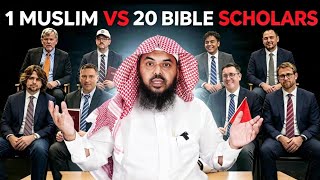 1:22:10
20 Christians vs 1 Muslim — Uthman ibn Farooq at Southern Baptist Theological Seminary
A structured debate between Shaykh Uthman ibn Farooq and twenty students and professors from the Southern Baptist Theological Seminary — the largest Baptist Bible university in America — held in Louisville, Kentucky. The debate rotates through four prompts via a flag-vote elimination mechanism: (1) The Prophet Muhammad is clearly mentioned in the Bible; (2) Jesus is not God according to the Bible; (3) Jesus is a prophet and servant of God; and (4) the Bible is not 100% preserved. Participants include a Conservative Presbyterian, a Biblical Unitarian pastor, Catholic and non-denominational students, an Episcopalian, and others. Key arguments cover Song of Solomon 5:16 (Muhammadim), Isaiah 42 (Kedar, Sal'a, Mushallam), ego imai in Luke and John, divine omniscience and hypostatic union, Acts 3:13, Hebrews 2:7-9, the Johannine Comma, Mark 16:9-20, Matthew-Luke genealogy contradictions, and the manuscript and chain-of-transmission preservation of the Quran.
Debate Excerpts (14)
Individual points from debates discussing this topic
“What is the first prompt and how is the Song of Solomon established as prophetic text, not merely a love poem?”
The first prompt is: the Prophet Muhammad is clearly mentioned in the Bible. Uthman opens by establishing that the Song of Solomon is not merely a love song. The Orthodox annotated Bible and the Oxford New Annotated Bible both describe it as prophetic speech involving mystical symbolism and highly figurative language. For centuries, critical biblical scholars understood the Song of Solomon as pointing to a coming prophetic figure — the allegory showing the relationship between God and who He would send to guide Israel and the people. That prophetic character is the context for the name appearing in Song of Solomon 5:16.
“What does the Hebrew-English lexicon show about the word Muhammadim in Song of Solomon 5:16?”
Uthman presents a printout from the Hebrew-English lexicon (with Strong numbers), showing that the word in Song of Solomon 5:16 is Muhammadim. The lexicon — written entirely by Christian scholars — lists the root as Hamida, which is the same Arabic root from which the name Muhammad is derived. This is not a Muslim source: it is a standard scholarly Christian reference used for Bible translation. The entry explicitly shows the Arabic cognate Hamida beside the Hebrew entry for Muhammadim, and lists Muhammad as a related noun. The lexicon even references the Arabic origin of the word.
“What does the plural suffix -im on Muhammadim mean and why does it not negate the name?”
The -im suffix in Hebrew is a masculine plural marker, but it is also used as a plural of majesty — the same way Elohim is used for God (grammatically plural but referring to one divine being). In Arabic, the same respectful plural form exists: the greeting Alaikum is grammatically plural but is used for a single person out of respect. So Muhammadim is Muhammad with the -im of honor and majesty attached — not a claim that there are multiple Muhammads. The construction is parallel to Elohim: the suffix intensifies honor, it does not change the singular referent.
“Why should Muhammadim be transliterated as a proper name rather than translated as an adjective meaning most lovely?”
Proper nouns in the Bible are never translated by meaning — they are always kept as names. The name David comes from a Hebrew root meaning beloved or cherished, but the Bible never says the most beloved or the cherished one — it always says David. Similarly, the name Muhammad in the Hebrew text should be kept as Muhammad, not rendered as the most lovely or the most praised. The lexicon written by Christian scholars even notes that in Arabic, Muhammad is a masculine noun — a proper name. Since the lexicon confirms the Arabic root and lists it as a noun, the name Muhammad is present in Song of Solomon 5:16 and should be preserved as a name in translation.
“Who were Abdullah ibn Salam and Ka'b ibn Akhbar and what is their significance to Muhammad being in scripture?”
Uthman presents a scan of a handwritten manuscript — Al-Shifa by Qadi Ayyad, from an actual museum collection — showing that two prominent Jewish scholars at the time of the Prophet, Abdullah ibn Salam and Ka'b ibn Akhbar, converted to Islam. Both men were deeply learned in the Old Testament scriptures. When they encountered the Prophet Muhammad in person, they recognized him as the prophet described in their scriptures and accepted Islam on that basis. Their accounts confirm that even well-versed Jewish scholars of that era believed the Bible contained descriptions pointing to Muhammad.
“What does Isaiah 42 say about the chosen servant as a light to the Gentiles?”
Isaiah 42 declares: I will put my spirit upon him, my beloved servant — he will be a light to the Gentiles. The passage frames this not as a mission primarily to Israel but to the wider world. Uthman notes this is sometimes claimed to refer to Jesus or John the Baptist. But the passage immediately continues to specify the Arabian context — the people of Kedar and the inhabitants of Sela — which are explicitly Arabian locations, not areas near Jerusalem or Palestine.
“Where are Kedar and Sala and what do they reveal about the identity of the coming prophet?”
According to Smith's Bible Dictionary — a Christian source — Kedar is the name given to the second son of Ishmael, from whom the Arab tribes descended. These Arab tribes gathered collectively in Mecca and were called Kedar. Sal'a (Sela) is a mountain in Medina. Uthman states he has physically visited Sal'a and confirmed that the Jewish community that once lived in Medina had a graveyard and a place of worship at this location because they understood it to be a biblical site. Sal'a is verifiable on Google Maps today. When Isaiah says the villages of Kedar will sing and the people of Sela will shout from mountaintops, this points to Arabia — specifically Mecca and Medina.
“What do the Jewish Encyclopedia and Bible Gateway say about Kedar and the lineage of Muhammad?”
The Jewish Encyclopedia identifies Kedar as the ancestor of the Arab tribes from whose lineage Muhammad came. Bible Gateway — a Christian resource — states that the northern Arabian tribes of Kedar are what we now call the Arabs, and that the genealogy of Muhammad in the Islamic tradition traces back through the descent of Abraham through Ishmael through Kedar. Both of these sources are non-Muslim. They independently confirm that Kedar in Isaiah 42 points to the Arabian origin of the Prophet Muhammad — making the Isaiah passage a clear geographic pointer to the Arab prophet.
“What is Mushallam in Isaiah 42:19 and how does it connect the passage to Islam?”
Isaiah 42:19 reads: who is blind but my servant, or deaf but my messenger whom I sent — who is blind as he who was perfect? The Hebrew word rendered as perfect in this verse is Mushallam. Uthman presents the Brown-Driver-Briggs Hebrew-English Lexicon, which shows that Mushallam carries the same root as the Arabic verb Aslama — the very root of the word Muslim. The passage therefore not only mentions Muhammadim (from Song of Solomon 5:16) but in Isaiah 42 also calls the coming prophet Mushallam (Muslim) — in the same passage that identifies the celebrating people as the Arabs of Kedar (Mecca) and Sal'a (Medina).
“How does Uthman defend the lexicographic argument against the theological hermeneutic objection?”
Uthman distinguishes the theological question (who does the passage ultimately point to?) from the linguistic question (what word is actually in the text?). When Bible translators do their work, they use lexicons — not theological presuppositions — to determine what a word means. The lexicon Uthman presents is written by Christian scholars and has nothing to do with Islamic interpretation. It independently lists the Arabic root Hamida as the source of the Hebrew Muhammadim and records Muhammad as a derived noun. Whether one believes the passage is about Jesus or Muhammad is a separate debate. But the word Muhammad — from Hamida — is present in the text. That is a factual linguistic claim, confirmed by the same reference tools used for translation.
“What is the final agreed position on the Song of Solomon linguistic argument?”
The exchange concludes with a clear agreement: at least from a linguistic perspective, the word written in Song of Solomon 5:16 is Muhammadim — Muhammad with the -im of respect and honor — derived from the root Hamida in Arabic, which is the same root as the name Muhammad. The Presbyterian scholar confirms this. The theological question of whether the prophecy ultimately refers to the Prophet Muhammad or to Jesus remains a point of disagreement, but the linguistic presence of the name is not disputed.
“How does the complete Isaiah 42 passage fit Muhammad but not Jesus when read in full?”
Uthman argues that Isaiah 42 taken as a whole describes a prophet who: (1) will be a light to the Gentiles, sent primarily to them rather than to the lost sheep of Israel; (2) the villages of Kedar (Mecca) and the people of Sal'a (Medina) will celebrate his coming; (3) he will prevail against his enemies as a man of war; and (4) he is called Mushallam (Muslim). Uthman explicitly states he believes in the second coming of Jesus — so he is not arguing against it. But even granting the second-coming interpretation for the military element, the geographic references (Kedar = Arabia/Mecca, Sal'a = Medina) and the title Mushallam (Muslim) cannot be applied to Jesus under any reading — first or second coming. Jesus did not primarily target the Gentiles and stated he was sent to the lost sheep of Israel (Matthew 15:24). Even MacArthur's Study Bible concedes the man-of-war elements refer to a second coming because Jesus did not defeat his enemies militarily in the first. But all these elements — Arab geography, military victory, and the title Muslim — fit the Prophet Muhammad in one unified, historical event.
“Is the age of Aisha recorded in the Quran?”
No. The age of Aisha is NOT in the Quran. This is the first critical point. In hadith sciences, we classify narrations by their chain of transmission. A Marfu' hadith is a direct statement from the Prophet ﷺ. A Mawquf hadith is a statement from a Companion (Sahabi). The narrations about Aisha's age are Mawquf — they come from Aisha herself reporting what she was told, not from the Prophet ﷺ. Furthermore, the narrations themselves are inconsistent: Sahih al-Bukhari records the age as 6, while Sahih Muslim records it as 7. This inconsistency exists because there was no formal calendar system in pre-Islamic Arabia. Ages were approximations based on what others told you.
“What does 'Marfu', 'Mawquf', and 'hadith Qudsi' mean?”
In the science of hadith, there are three classifications based on who the statement reaches back to: 1. Hadith Qudsi (Sacred hadith): Words of Allah conveyed through the Prophet ﷺ but not part of the Quran. 2. Marfu' hadith: A statement, action, or approval directly attributed to the Prophet ﷺ himself. 3. Mawquf hadith: A statement from a Companion (Sahabi) — it stops at the Companion and does not go back to the Prophet ﷺ. The narrations about Aisha's age are Mawquf — Aisha reporting what she was told about her own age by others. The Prophet ﷺ never stated how old Aisha was. So when someone says 'your Quran says she was 6' or 'your Prophet said she was 6,' both claims are factually wrong. It's not in the Quran and it's not a statement of the Prophet ﷺ.
Questions (10)
Did Buddhist scriptures predict the coming of Prophet Muhammad ﷺ?
Muslim scholars argue that the six criteria given for identifying the 'next Buddha' — as recorded in the Gospel of Buddha compiled by Paul Carus — match Prophet Muhammad ﷺ precisely on all six points: attaining supreme insight at night, looking exceedingly bright at enlightenment, dying a natural death, dying at night, looking bright before death, and ceasing to exist on earth after death. Important caveat: the text cited is a 19th-century Western compilation, not a classical canonical Buddhist scripture.
Does the Bible actually predict the coming of Prophet Muhammad ﷺ?
Muslims present three key categories of biblical evidence that point to Muhammad ﷺ: (1) Deuteronomy 18:18 — a prophet 'like Moses' from among the brothers of the Israelites; (2) John 14–16 — the Paraclete (Comforter/Advocate) described with attributes matching a prophet, not a spirit; (3) the Song of Solomon 5:16 — where the Hebrew word *machmaddim* (חמדים) is a direct cognate of the name Muhammad. Christian scholars dispute these interpretations. The Muslim case rests on textual analysis and the internal logic of prophecy.
In what ways was Prophet Muhammad ﷺ similar to Moses, as Deuteronomy 18 prophesied?
Deuteronomy 18:18 prophesies a prophet 'like Moses from among their brethren.' When tested against six key biographical criteria, Prophet Muhammad ﷺ matches all six — natural birth, marriage with children, natural death, bringing a new law, worldly leadership, and acceptance by his own people. Jesus (peace be upon him) matches none of the six criteria, making Muhammad ﷺ the unique and precise fulfillment of this prophecy.
Is Isaiah 29:12 a prophecy about Prophet Muhammad ﷺ?
Islamic scholars identify Isaiah 29:12 as a precise description of the first revelation received by Prophet Muhammad ﷺ. The verse reads: 'And the book is delivered to him that is not learned, saying, Read this, I pray thee: and he saith, I am not learned.' This is a verbatim match to the moment Angel Jibreel commanded 'Iqra!' (Read!) and the Prophet ﷺ responded 'Ma ana bi-qari'' (I am not learned) — the exact exchange recorded in Sahih al-Bukhari.
What is the historical context of the Prophet Muhammad ﷺ's marriage to Aisha?
The marriage of Prophet Muhammad ﷺ to Aisha must be understood within the social norms of 7th-century Arabia. The age of Aisha is not mentioned in the Qur'an nor in any Marfu' hadith (direct statement of the Prophet ﷺ). The narrations come from Aisha herself, who gave varying ages (6 and 7 for betrothal), reflecting the inexact nature of age-tracking in a society without birth certificates or a formal calendar. She was already engaged to someone else before the Prophet ﷺ — proving she was at a customary marriageable age for that era. They waited until she was physically and mentally ready for marriage, and nobody in that society — not even the Mushrikun who opposed the Prophet ﷺ in everything — objected, because early marriage was the universal norm across all cultures at that time.
Was Prophet Muhammad ﷺ violent or did he spread Islam by the sword?
No. Historical evidence and his own sayings demonstrate the opposite — he was exceptionally forgiving, patient, gentle, and tolerant, even when he had the power to retaliate. He prohibited harming civilians, instructed kindness toward prisoners, forgave those who persecuted him, and commanded that conquered peoples be treated with justice.
What are the main objections critics raise against Muhammad ﷺ being in the Bible, and how do Muslims respond?
Critics raise four primary objections: (1) Deuteronomy 18 requires the prophet to come from among the Israelites, not Arabs; (2) John 14's Paraclete refers to the Holy Spirit, not a human prophet; (3) Song of Solomon's 'machmedim' is romantic poetry, not a prophecy; (4) 'Paran' in Deuteronomy 33 is Sinai, not Arabia. A fifth meta-objection is the 'awkward silence' — no pre-Islamic Jewish or Christian scholar documented these texts as pointing to Muhammad ﷺ. Each objection has a substantive Muslim response.
What does the Bhavishya Purana say about Prophet Muhammad ﷺ?
The Bhavishya Purana — one of Hinduism's 18 major Puranas — contains a passage that Muslim scholars argue explicitly names 'Muhammad' and describes his followers with seven characteristics that match Islamic practice precisely: circumcision, no topknot on the head, keeping beards, announcing the Adhan (call to prayer), eating all lawful food except pork, striving in God's path, and being known as Muslims. Note: The age and authenticity of this specific passage are disputed among scholars.
What is the Paraclete in John 14–16 and does it refer to Prophet Muhammad ﷺ?
The Paraclete (Greek: παράκλητος, *parakletos*) is a figure promised by Jesus ﷺ in his farewell discourse (John 14–16), described as one who will guide into all truth, speak only what he hears, and whose coming requires Jesus's departure. Christian theology identifies this as the Holy Spirit. Muslim scholars argue the description matches a human prophet — specifically Muhammad ﷺ — pointing to the attributes of external speech, future foretelling, and a contested manuscript variant (*periklutos* = the praised one = Muhammad).
Who is Prophet Muhammad ﷺ and what was his character like?
Muhammad ﷺ is the final Prophet sent by God to all of humanity. His character was described by his wife Aisha as 'a reflection of the Qur'an.' He was known for extraordinary mercy, forgiveness, humility, equality, and gentleness — even celebrated by non-Muslim scholars like Mahatma Gandhi and George Bernard Shaw as one of history's greatest figures.
Articles (4)
Biblical Prophecies on the Advent of Muhammad ﷺ, the Prophet of Islam
Evidence from the Bible pointing to the coming of the final Prophet
Islamic Research Foundation
The Biblical prophecies on the advent of the Prophet Muhammad ﷺ are evidence of the truth of Islam for people who believe in the Bible. This article examines prophecies from Deuteronomy, Isaiah, John, and Genesis that point to a prophet like Moses — from among the Ishmaelites — into whose mouth God would put His words.
15 Common Misconceptions About Islam — Addressed and Clarified
A comprehensive response to the most widespread myths surrounding Islam, Muslims, and the Qur'an
Compiled from Islamic Scholarship
From headlines linking Islam to extremism to centuries-old myths about the nature of Allah and the status of women, misconceptions about Islam are among the most pervasive in the modern world. This article systematically addresses fifteen of the most common misunderstandings — drawing from the Qur'an, the authenticated Sunnah, and the findings of non-Muslim historians and scholars — to offer a clear, evidence-based clarification for any sincere seeker of truth.
Prophet Muhammad ﷺ in the Bible, Torah, and World Scriptures: The Complete Evidence
How the Torah, Gospels, Hindu Vedas, and Buddhist scriptures all prophesied the final Messenger of God
TheOpenQuran Research
Is Muhammad ﷺ mentioned in the Bible, Torah, and world scriptures? Yes — and this is the complete evidence. From Deuteronomy 18:18 and Isaiah 42 to Song of Solomon's 'Muhammadim' in Hebrew, the Gospel of John's Comforter, the Hindu Bhavishya Purana naming him explicitly, the Vedas' Narasansha, and the Buddhist six-criteria prophecy — every major tradition points to one man.
Is Muhammad ﷺ Really in the Bible? The Evidence, the Objections, and the Answers
A rigorous examination of the Quranic claim, the textual evidence, and every major scholarly challenge
TheOpenQuran Research
The Quran explicitly claims that Prophet Muhammad ﷺ is described by name in the Torah and the Gospel, and that Jesus himself predicted him. Critics raise four major objections to the Muslim textual evidence. This article presents the strongest case for each objection — and then systematically answers each one using historical, linguistic, and logical analysis drawn from the work of Dr. Zakir Naik, comparative religion scholars, and the Quran itself.
Hadith (2)
مَنْ لاَ يَرْحَمْ لاَ يُرْحَمْ
Man la yarham la yurham
Narrated by Abu Hurairah
أَنَا أَوْلَى النَّاسِ بِابْنِ مَرْيَمَ، وَالأَنْبِيَاءُ أَوْلاَدُ عَلاَّتٍ، لَيْسَ بَيْنِي وَبَيْنَهُ نَبِيٌّ
Ana awla an-nasi bi ibni Maryam, wal-anbiya'u awladu 'allat, laysa bayni wa baynahu nabiyy
Narrated by Abu Hurairah