Mushallam
3 items across 2 content types
Debates (1)
 1:22:10
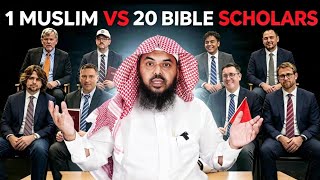
20 Christians vs 1 Muslim — Uthman ibn Farooq at Southern Baptist Theological Seminary
A structured debate between Shaykh Uthman ibn Farooq and twenty students and professors from the Southern Baptist Theological Seminary — the largest Baptist Bible university in America — held in Louisville, Kentucky. The debate rotates through four prompts via a flag-vote elimination mechanism: (1) The Prophet Muhammad is clearly mentioned in the Bible; (2) Jesus is not God according to the Bible; (3) Jesus is a prophet and servant of God; and (4) the Bible is not 100% preserved. Participants include a Conservative Presbyterian, a Biblical Unitarian pastor, Catholic and non-denominational students, an Episcopalian, and others. Key arguments cover Song of Solomon 5:16 (Muhammadim), Isaiah 42 (Kedar, Sal'a, Mushallam), ego imai in Luke and John, divine omniscience and hypostatic union, Acts 3:13, Hebrews 2:7-9, the Johannine Comma, Mark 16:9-20, Matthew-Luke genealogy contradictions, and the manuscript and chain-of-transmission preservation of the Quran.
Debate Excerpts (2)
Individual points from debates discussing this topic
“What is Mushallam in Isaiah 42:19 and how does it connect the passage to Islam?”
Isaiah 42:19 reads: who is blind but my servant, or deaf but my messenger whom I sent — who is blind as he who was perfect? The Hebrew word rendered as perfect in this verse is Mushallam. Uthman presents the Brown-Driver-Briggs Hebrew-English Lexicon, which shows that Mushallam carries the same root as the Arabic verb Aslama — the very root of the word Muslim. The passage therefore not only mentions Muhammadim (from Song of Solomon 5:16) but in Isaiah 42 also calls the coming prophet Mushallam (Muslim) — in the same passage that identifies the celebrating people as the Arabs of Kedar (Mecca) and Sal'a (Medina).
“How does the complete Isaiah 42 passage fit Muhammad but not Jesus when read in full?”
Uthman argues that Isaiah 42 taken as a whole describes a prophet who: (1) will be a light to the Gentiles, sent primarily to them rather than to the lost sheep of Israel; (2) the villages of Kedar (Mecca) and the people of Sal'a (Medina) will celebrate his coming; (3) he will prevail against his enemies as a man of war; and (4) he is called Mushallam (Muslim). Uthman explicitly states he believes in the second coming of Jesus — so he is not arguing against it. But even granting the second-coming interpretation for the military element, the geographic references (Kedar = Arabia/Mecca, Sal'a = Medina) and the title Mushallam (Muslim) cannot be applied to Jesus under any reading — first or second coming. Jesus did not primarily target the Gentiles and stated he was sent to the lost sheep of Israel (Matthew 15:24). Even MacArthur's Study Bible concedes the man-of-war elements refer to a second coming because Jesus did not defeat his enemies militarily in the first. But all these elements — Arab geography, military victory, and the title Muslim — fit the Prophet Muhammad in one unified, historical event.