Divine Attributes
13 items across 3 content types
Debates (2)
 2:54:50
Muslim Faces 10 — Jesus Is Not Almighty God According to the Bible
A structured summary of a long debate about whether Jesus is Almighty God according to the Bible, followed by a second prompt about whether Muhammad is clearly mentioned in the Bible. The discussion repeatedly turns on Bible verses about Jesus and God, Qur'anic names and titles, shirk, takfir, translation differences, Psalm 83:18, Jeremiah 23:5-6, Revelation 1 and 22, manuscript corruption, and Qur'anic authority over previous scripture.
 1:22:10
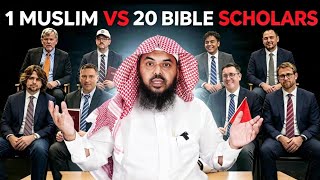
20 Christians vs 1 Muslim — Uthman ibn Farooq at Southern Baptist Theological Seminary
A structured debate between Shaykh Uthman ibn Farooq and twenty students and professors from the Southern Baptist Theological Seminary — the largest Baptist Bible university in America — held in Louisville, Kentucky. The debate rotates through four prompts via a flag-vote elimination mechanism: (1) The Prophet Muhammad is clearly mentioned in the Bible; (2) Jesus is not God according to the Bible; (3) Jesus is a prophet and servant of God; and (4) the Bible is not 100% preserved. Participants include a Conservative Presbyterian, a Biblical Unitarian pastor, Catholic and non-denominational students, an Episcopalian, and others. Key arguments cover Song of Solomon 5:16 (Muhammadim), Isaiah 42 (Kedar, Sal'a, Mushallam), ego imai in Luke and John, divine omniscience and hypostatic union, Acts 3:13, Hebrews 2:7-9, the Johannine Comma, Mark 16:9-20, Matthew-Luke genealogy contradictions, and the manuscript and chain-of-transmission preservation of the Quran.
Debate Excerpts (9)
Individual points from debates discussing this topic
“What about God's 'face' and 'parts' in the Quran?”
The 'face' (wajh) of God in Arabic is understood as referring to God's essence or self — 'wajh' also means 'direction,' 'aspect,' or 'being.' The ayah 'everything will perish except His face' means 'everything will perish except Him.' This is standard Arabic usage, not anthropomorphism. The Athari, Ash'ari, and Maturidi schools all address this: divine attributes are affirmed 'without how' (bila kayf) — they are not physical parts, and the Arabic does not require that reading.
“How is the names-and-attributes question answered?”
The reply is that some sifat are unique to Allah, such as Ar-Rahman, while others can be used for creation in a qualified sense, such as Rahim or loving. The argument is that there is a difference between sharing a word in a restricted context and applying Allah's unique attributes to a creature in a way that rivals Him.
“What does Mark 13:32 say about Jesus and knowledge of the Day of Judgment?”
Uthman quotes Mark 13:32 (also in Matthew 24:36): of that day and hour no one knows, not even the angels in heaven, nor the Son, but only the Father. God is all-knowing at all times — this is a fundamental divine attribute. But here Jesus himself says he does not know the hour. If Jesus is God and God is all-knowing, then Jesus must know the hour. The verse explicitly says the Son does not know. Therefore, either Jesus is not God, or the verse is false.
“Can an all-knowing God simultaneously not know something, even through a human nature?”
Uthman presses the logical contradiction: God is all-knowing at all times. This is not a negotiable attribute — it is part of what makes God, God. Just as God cannot lie (Numbers 23:19 states God is not a man that he should lie), God cannot fail to know something. He then specifically isolates the ability-to-know distinction the Catholic used: "I did not ask you if you had the ability to. That is like me saying I have the ability to work out and lift 350 pounds, but I cannot." The student replies: "Or you are just not doing it right now." Uthman confirms: exactly — so at that moment Jesus genuinely did not know the hour. He then returns to the divine attribute: God is all-knowing at ALL times. A being that does not know something at any moment, for any reason, cannot be God. The same argument applies to death: God cannot die, but Christians say Jesus died. Either Jesus is God (and these events did not truly happen) or Jesus died and was not God.
“If Jesus limited himself and was no longer all-knowing, is he still God by definition?”
Uthman reaches the crux of the argument: the Catholic said Jesus limited himself and therefore did not know the hour. But God is all-knowing at all times — this is the essence of God. To say God limited his omniscience is to say God stopped being all-knowing. But if God stopped being all-knowing, he stopped being God. You cannot have a being who is God and simultaneously not know something — regardless of the reason. The same logic applies to death: God cannot die. If Jesus died on the cross, the dying entity cannot have been God. The Catholic responds by saying God is a complex entity, but Uthman points out that complexity does not resolve a logical contradiction.
“What does the fig tree incident and Jesus's human needs reveal about his divine nature being present?”
Uthman asks: if the divine nature was present in Jesus at all times and is fully omniscient, how did Jesus not know whether a fig tree had fruit on it? He went to check. He also had to eat, sleep, and perform all human biological functions. If the divine nature was truly present and omniscient, and if the one person of Jesus has access to both natures, then Jesus should have known everything the divine nature knows — including whether the fig tree had fruit. The participant gives the same answer: the person knows through the divine nature, but the human nature did not know. Uthman asks: does that make sense to you, really? The participant pauses and ultimately says no, it does not make sense to him.
“Why is omniscience a non-negotiable divine attribute, unlike power limitations?”
Uthman argues that all-knowledge is essential to what God is — it cannot be limited even voluntarily without God ceasing to be God. He uses an analogy: if you say a monkey is God and argue it is a mystery, that fails — we can clearly say a being that throws excrement is not God. Similarly, if a being does not know something (like the hour of judgment), we can say with certainty that this being is not God — because God is all-knowing at all times by definition. The core attributes of God must be understandable enough to be the basis of faith. If Jesus did not know the hour, by definition he is not God.
“What does Numbers 23:19 say about the divine nature and lying?”
When the topic of whether God can lie comes up, Robin challenges the claim by invoking Job: "Somebody said that God never lied, and I thought immediately about Job. God told Job some whoppers just to check him out." Uthman acknowledges the exchange and responds with Numbers 23:19: God is not a man that he should lie. This is a direct biblical statement distinguishing the divine nature from human fallibility. Robin says she does not take the Bible literally anyway, so the verse carries limited force for her. Uthman uses it to establish the broader point: if there are things God categorically does not do (such as lie), then omniscience is another such essential attribute — and a being that does not know something at any moment cannot be God.
“What happens to those who never received the Islamic message?”
Uthman distinguishes between those who received the message and those who did not. For a person who lived somewhere the message of Islam never reached — on an island, in a remote community, in a time before the message spread — Allah will not judge them for what they did not know. God is merciful and just. They will be rewarded for the good they did and for how they recognized and reached toward God with the understanding available to them. This is the principle: no soul is burdened with more than it can bear. The one who genuinely could not have known is judged differently from the one who knew and rejected.
Qur'an Verses (2)
هُوَ الْأَوَّلُ وَالْآخِرُ وَالظَّاهِرُ وَالْبَاطِنُ ۖ وَهُوَ بِكُلِّ شَيْءٍ عَلِيمٌ
Huwa al-Awwalu wal-Akhiru waz-Zahiru wal-Batinu wa Huwa bikulli shay'in 'Alim
“He is the First and the Last, the Ascendant and the Intimate, and He is, of all things, Knowing.”
ٱللَّهُ لَآ إِلَـٰهَ إِلَّا هُوَ ٱلْحَىُّ ٱلْقَيُّومُ ۚ لَا تَأْخُذُهُۥ سِنَةٌ وَلَا نَوْمٌ ۚ لَّهُۥ مَا فِى ٱلسَّمَـٰوَٰتِ وَمَا فِى ٱلْأَرْضِ ۗ مَن ذَا ٱلَّذِى يَشْفَعُ عِندَهُۥٓ إِلَّا بِإِذْنِهِۦ ۚ يَعْلَمُ مَا بَيْنَ أَيْدِيهِمْ وَمَا خَلْفَهُمْ ۖ وَلَا يُحِيطُونَ بِشَىْءٍ مِّنْ عِلْمِهِۦٓ إِلَّا بِمَا شَآءَ ۚ وَسِعَ كُرْسِيُّهُ ٱلسَّمَـٰوَٰتِ وَٱلْأَرْضَ ۖ وَلَا يَـُٔودُهُۥ حِفْظُهُمَا ۚ وَهُوَ ٱلْعَلِىُّ ٱلْعَظِيمُ
Allahu la ilaha illa Huwa al-Hayyu al-Qayyum. La ta'khudhuhu sinatun wa la nawm. Lahu ma fis-samawati wa ma fil-ard. Man dhal-ladhi yashfa'u 'indahu illa bi idhnihi. Ya'lamu ma bayna aydihim wa ma khalfahum. Wa la yuhituna bishay'in min 'ilmihi illa bima sha'. Wasi'a kursiyyuhus-samawati wal-ard. Wa la ya'uduhu hifzuhuma. Wa Huwa al-'Aliyyu al-'Azim
“Allah — there is no deity except Him, the Ever-Living, the Self-Sustaining. Neither drowsiness overtakes Him nor sleep. To Him belongs whatever is in the heavens and whatever is on the earth. Who is it that can intercede with Him except by His permission? He knows what is before them and what will be after them, and they encompass not a thing of His knowledge except for what He wills. His Kursi extends over the heavens and the earth, and their preservation tires Him not. And He is the Most High, the Most Great.”