Objective Morality
7 items across 2 content types
Debates (1)
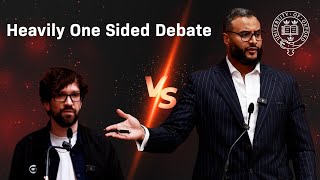 1:03:18
Mohammed Hijab vs Destiny — Islam and Atheism
A structured, comprehensive summary of Mohammed Hijab and Destiny debating Islam, atheism, secularism, morality, immigration, and social order. This entry preserves the full argumentative flow and key exchanges from the transcript.
Debate Excerpts (6)
Individual points from debates discussing this topic
“How does Hijab challenge the atheism-to-liberalism link?”
Hijab argues Destiny imported liberalism into a debate about atheism vs Islam without demonstrating a necessary entailment from atheism to liberal moral order. He repeatedly presses for an objective bridge from materialist premises ('atoms in motion') to normative moral claims ('ought'), invoking the is-ought problem and arguing this remains unresolved in atheist frameworks.
“How does Hijab respond to the legal-tolerance challenge?”
Hijab argues the burden remains on Destiny to justify liberalism's truth and to derive objective normativity from atheism before using liberal criteria as universal arbiters. He presents this as a category error: evaluating Islam by a framework whose own foundations were not established in the debate.
“How does Hijab structure the argument that atheism lacks objective moral grounding?”
Hijab distinguishes epistemology (how we know moral claims) from ontology (what makes them objectively true). He references major non-theistic ethical traditions (deontology, consequentialism, virtue ethics) and argues they do not secure mind-independent moral objectivity. He claims objective morality requires transcendence beyond human preference and social consensus.
“How does Hijab answer the intuition-based model?”
Hijab argues intuitive recognition does not itself establish objective truth conditions. He says citing social upbringing or interpretive diversity does not refute truth-apt religion, just as disagreement in other domains does not erase facticity. He maintains the key unresolved issue is still ontological grounding for universal moral authority.
“How does Hijab explain legal adaptation in Islam while claiming objective morality?”
Hijab argues Sharia draws from multiple usul sources beyond only Quran/Hadith, including juristic principles around harm and benefit. He says this allows principled adaptation to new circumstances without abandoning objective moral anchors. He distinguishes between immutable foundations and variable rulings within jurisprudential method.
“What is the basis of objective morality in Islam compared to subjective human morality?”
Uthman explains that without God as the source, the definition of a good person is entirely subjective. Different people hold different views on abortion, the death penalty, euthanasia, and other moral questions — and without an objective standard, all of these are equally valid or invalid. As a Muslim, Uthman submits to the objective morality of Allah. He is good to his neighbors not merely because he feels like it, but because his religion commands it. This gives morality a stable foundation that does not shift with individual or cultural preference.