Atheism
6 items across 2 content types
Debates (1)
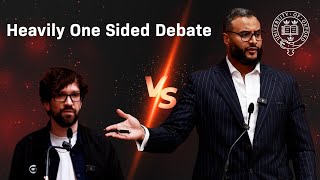 1:03:18
Mohammed Hijab vs Destiny — Islam and Atheism
A structured, comprehensive summary of Mohammed Hijab and Destiny debating Islam, atheism, secularism, morality, immigration, and social order. This entry preserves the full argumentative flow and key exchanges from the transcript.
Debate Excerpts (5)
Individual points from debates discussing this topic
“What opening theological case is presented for Islam over atheism?”
Hijab opens with a teleological and cosmological line: the universe appears orderly, stable, and goal-directed, raising the question of whether knowledge/intelligence or lack thereof best explains existence. He argues that 'something from nothing' and self-causation are incoherent, then concludes that one ultimate source of being (monotheism) is the most rational conclusion.
“What direct critique of atheism is made in the opening?”
Hijab argues atheism is primarily a negation and lacks independent explanatory force for foundational domains such as morality, rationality, and consciousness. He concludes by challenging atheism to provide constructive, rather than merely critical, metaphysical grounding.
“How does Hijab challenge the atheism-to-liberalism link?”
Hijab argues Destiny imported liberalism into a debate about atheism vs Islam without demonstrating a necessary entailment from atheism to liberal moral order. He repeatedly presses for an objective bridge from materialist premises ('atoms in motion') to normative moral claims ('ought'), invoking the is-ought problem and arguing this remains unresolved in atheist frameworks.
“How does Hijab respond to the legal-tolerance challenge?”
Hijab argues the burden remains on Destiny to justify liberalism's truth and to derive objective normativity from atheism before using liberal criteria as universal arbiters. He presents this as a category error: evaluating Islam by a framework whose own foundations were not established in the debate.
“How does Hijab structure the argument that atheism lacks objective moral grounding?”
Hijab distinguishes epistemology (how we know moral claims) from ontology (what makes them objectively true). He references major non-theistic ethical traditions (deontology, consequentialism, virtue ethics) and argues they do not secure mind-independent moral objectivity. He claims objective morality requires transcendence beyond human preference and social consensus.