Comparative Religion
90 items across 6 content types
Debates (5)
 1:03:18
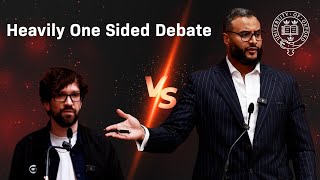
Mohammed Hijab vs Destiny — Islam and Atheism
A structured, comprehensive summary of Mohammed Hijab and Destiny debating Islam, atheism, secularism, morality, immigration, and social order. This entry preserves the full argumentative flow and key exchanges from the transcript.
 3:07:20
Mohammed Hijab vs David Wood — Trinity or Tawhid?
A full structured debate between Mohammed Hijab and David Wood on the core theological question: Is God's nature best understood through the Islamic concept of Tawhid (absolute oneness) or the Christian doctrine of the Trinity? Hosted by York College MSA in New York.
 2:54:50
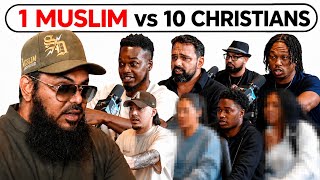
Muslim Faces 10 — Jesus Is Not Almighty God According to the Bible
A structured summary of a long debate about whether Jesus is Almighty God according to the Bible, followed by a second prompt about whether Muhammad is clearly mentioned in the Bible. The discussion repeatedly turns on Bible verses about Jesus and God, Qur'anic names and titles, shirk, takfir, translation differences, Psalm 83:18, Jeremiah 23:5-6, Revelation 1 and 22, manuscript corruption, and Qur'anic authority over previous scripture.
 1:22:10
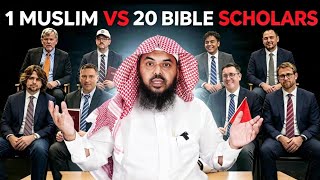
20 Christians vs 1 Muslim — Uthman ibn Farooq at Southern Baptist Theological Seminary
A structured debate between Shaykh Uthman ibn Farooq and twenty students and professors from the Southern Baptist Theological Seminary — the largest Baptist Bible university in America — held in Louisville, Kentucky. The debate rotates through four prompts via a flag-vote elimination mechanism: (1) The Prophet Muhammad is clearly mentioned in the Bible; (2) Jesus is not God according to the Bible; (3) Jesus is a prophet and servant of God; and (4) the Bible is not 100% preserved. Participants include a Conservative Presbyterian, a Biblical Unitarian pastor, Catholic and non-denominational students, an Episcopalian, and others. Key arguments cover Song of Solomon 5:16 (Muhammadim), Isaiah 42 (Kedar, Sal'a, Mushallam), ego imai in Luke and John, divine omniscience and hypostatic union, Acts 3:13, Hebrews 2:7-9, the Johannine Comma, Mark 16:9-20, Matthew-Luke genealogy contradictions, and the manuscript and chain-of-transmission preservation of the Quran.
 1:48:00
Shaykh Uthman vs Captain Tazaryach — Is the Bible the Word of God?
A heated debate between Shaykh Uthman Ibn Farooq (Muslim) and Captain Tazaryach (Hebrew Israelite) on whether the Bible is the preserved Word of God. Shaykh Uthman presents multiple internal contradictions in the Old Testament — including three conflicting accounts of King Saul's death, contradictory ages for King Ahaziah, and irreconcilable genealogies of Jesus in Matthew vs Luke vs 1 Chronicles. The debate concludes with an extensive discussion on underage marriage in biblical tradition, including Rashi's commentary on Rebekah's age and early Christian sources on Mary's age at marriage.
Debate Excerpts (46)
Individual points from debates discussing this topic
“How does Hijab answer the 'where are Muslim societies' objection?”
Hijab distinguishes Islam (normative revelation) from Muslims (fallible practitioners/states), conceding Muslim governments often fail Islamic ideals while denying this falsifies Islam's truth claims. He also argues liberal modernity coexisted with colonial violence, so contemporary liberal success claims cannot ignore historical moral costs.
“How does Hijab answer the intuition-based model?”
Hijab argues intuitive recognition does not itself establish objective truth conditions. He says citing social upbringing or interpretive diversity does not refute truth-apt religion, just as disagreement in other domains does not erase facticity. He maintains the key unresolved issue is still ontological grounding for universal moral authority.
“How does the Old Testament support absolute monotheism?”
The Shema (Deuteronomy 6:4) declares 'Hear O Israel, the Lord our God, the Lord is one.' Exodus 20:3 commands 'You shall have no other gods before me.' Isaiah 43:11 states 'I, even I, am the Lord, and besides me there is no saviour.' Isaiah 44:6 says 'I am the first and I am the last; besides me there is no God.' These passages use singular pronouns and emphatic language that leaves no room for a multi-personal God.
“What about the word 'Elohim' — doesn't its plural form suggest plurality in God?”
Elohim is a plural of majesty (pluralis majestatis), not a numerical plural. Hebrew grammar uses this for singular referents — the verb forms used with Elohim when referring to God are consistently singular. When Elohim refers to pagan gods as a true plural, the verbs are plural. The scholarly consensus is that this is a grammatical feature, not a theological one.
“Does the New Testament clearly teach the Trinity?”
Paul's writings treat Jesus as subordinate to the Father — 1 Corinthians 8:6 distinguishes 'one God, the Father' from 'one Lord, Jesus Christ.' In John 17:3, Jesus himself defines eternal life as knowing 'the only true God' — the Father — and Jesus Christ whom he sent, making a clear distinction. Mark 12:29 records Jesus affirming the Shema: the Lord our God is one Lord. Even the Trinitarian proof-text Matthew 28:19 ('baptising in the name of Father, Son, and Holy Spirit') appears in a form that Luke 9:26 and Acts 2:38 contradict.
“How does Hijab respond to the Genesis 'Let us' and 'Spirit of God' arguments?”
The 'Spirit of God' (ruach Elohim) in Genesis 1:2 means 'wind of God' or 'breath of God' in Hebrew — ruach is the standard word for wind/breath. Most Hebrew scholars read this as a description of the primordial state, not a second divine person. 'Let us make man in our image' (Genesis 1:26) is the plural of majesty — God speaking in royal plural, which is standard in ancient Near Eastern royal language. The very next verse (1:27) switches to singular: 'So God created man in His own image.'
“What about the 'I AM' claim and Isaiah 9:6 (Emmanuel)?”
Emmanuel means 'God is with us' — it's a theophoric name, not an ontological claim. Hebrew names routinely contain God's name: Elijah ('my God is Yahweh'), Daniel ('God is my judge'). Nobody claims Elijah is literally Yahweh because of his name. Similarly, 'Mighty God' in Isaiah 9:6 is debated — the Hebrew 'El Gibbor' can refer to a mighty hero or ruler. Even if it means 'Mighty God,' the same title is applied to human judges in Psalm 82.
“Is the Quran a 'second divine person' like the Christian Logos?”
The Quran is an attribute of God (kalaam Allah — God's speech), not a separate entity or person. An attribute is not a person. God's knowledge is eternal, God's power is eternal — but no one calls God's power a 'second god.' The hadith about the Quran interceding uses metaphorical language about the Day of Judgement — just as good deeds 'intercede' for a person. The Christian Logos doctrine says the Word is a person who became incarnate — the Quran is not a person and did not become incarnate.
“What about the pagan origins claim against Islamic practices?”
Abraham and Ishmael built the Ka'bah according to both Islamic tradition and the Quran (2:127). That pagans later corrupted monotheistic worship does not make the original practice pagan — Muhammad restored what Abraham established. By this logic, Christianity's December 25th celebration, Easter eggs, church steeples, and the concept of a dying-and-rising God could all be called pagan borrowings from Roman religion.
“Does the Quran get the Trinity wrong (Surah 5:116)?”
Wood's side often claims Surah 5:116 gets the Trinity wrong by including Mary. But the verse is asking Jesus whether he told people to worship him and his mother as gods — it's addressing actual historical practices (Marian veneration in certain Christian sects, the Collyridians), not defining the formal Trinitarian creed. The Quran is correcting popular Christian practice, not misunderstanding Nicene theology.
“Is the Holy Spirit co-equal with the Father? If so, why does Jesus say blasphemy against the Son is forgivable but blasphemy against the Spirit is not (Matthew 12:31-32)?”
If all three persons are co-equal, there should be no hierarchy of blasphemy. Yet Jesus himself ranks the Spirit above the Son in terms of blasphemy. This suggests the early Christians did not view the Son and Spirit as co-equal — the Spirit had a different, possibly higher, status.
“If Jesus is God, why does he say 'of that day and hour no one knows, not even the angels in heaven, nor the Son, but only the Father' (Mark 13:32)?”
An omniscient God cannot not-know something. If Jesus is fully God, he must know everything God knows. But he explicitly says he does not know the hour of judgement. This is not 'choosing not to use omniscience' — he says he does not know. This is a definitive statement of Jesus's non-omniscience, and therefore his non-divinity.
Justin Martyr explicitly says that Christianity's claims are similar to the sons of Zeus — he draws the parallel himself in his First Apology. He says 'when we say Jesus Christ was produced without sexual union, was crucified and died, and rose again and ascended into heaven, we propound nothing different from what you believe regarding the sons of Jupiter.' Justin is conceding the pagan parallel, not distinguishing from it. This is the earliest Trinitarian-adjacent Father admitting the direct line to Greek mythology.
“Don't Old Testament passages like Psalm 137:9 ('Happy is the one who seizes your infants and dashes them against the rocks') present a moral problem for the Christian claim of biblical inerrancy?”
If the Bible is God's word, God endorsed the killing of babies. This is not an argument about Trinity directly, but about the authority of the text from which Trinitarian proof-texts are drawn. If the OT contains morally repugnant passages, its theological authority is compromised.
The Islamic position is not that Ebionites were perfect Muslims — it's that their monotheism was closer to the truth than later Trinitarian theology. Islam came to correct all previous distortions. The Ebionites are evidence that the earliest Jesus followers were monotheists who did not worship Jesus — the deification was a later innovation. That the details of Ebionite theology differ from Islam is irrelevant; the point is about the trajectory from monotheism to Trinity being a theological drift.
I want to extend an olive branch. We will disagree on theology — and that is fine. But Muslims and Christians worship the same God, as the Quran says: 'Our God and your God is one' (29:46). We share more in common than we have in difference: belief in God, accountability, moral responsibility, love for Jesus, and respect for the prophetic tradition. Let us debate honestly but remain brothers in our shared humanity.
This actually reinforces the Islamic point: the Old Testament prohibits consuming blood, yet Christianity overrides this prohibition by claiming a new dispensation. This pattern — where later Christian theology overrides explicit Old Testament commands — is exactly how the Trinity emerged. The original monotheistic command ('the Lord is one') was overridden by a later Trinitarian dispensation. Christianity's entire theological method involves superseding what was clearly established.
“How does the Muslim side answer the Revelation 22 argument?”
The reply is that the verse still has to be read through the Bible's own linguistic and historical context, not through an imported Islamic semantic rule. The speaker argues that Greek and Arabic usage are not interchangeable and that the title can be read differently in the Christian textual world than in the Qur'anic one.
“How is sonship distinguished from physical begetting?”
The reply is that son language can be used as a term of endearment, including in Arabic examples such as walid, and therefore not every use of 'son' implies a literal divine relation. The speaker says the Christian argument is collapsing different linguistic uses into one, as if every son-language example must mean the same thing.
“Why did Shaykh Uthman challenge the Southern Baptist Theological Seminary?”
Shaykh Uthman ibn Farooq introduces himself from Louisville, Kentucky, in the South Bible Belt. He and his team came to the Southern Baptist Theological Seminary — the biggest Baptist Bible University in America — and challenged all professors and Bible scholars to a debate. Twenty of them accepted. The challenge is designed to demonstrate that the Islamic case for prophethood and biblical criticism can stand up to scrutiny from multiple opponents simultaneously.
“What is the first prompt and how is the Song of Solomon established as prophetic text, not merely a love poem?”
The first prompt is: the Prophet Muhammad is clearly mentioned in the Bible. Uthman opens by establishing that the Song of Solomon is not merely a love song. The Orthodox annotated Bible and the Oxford New Annotated Bible both describe it as prophetic speech involving mystical symbolism and highly figurative language. For centuries, critical biblical scholars understood the Song of Solomon as pointing to a coming prophetic figure — the allegory showing the relationship between God and who He would send to guide Israel and the people. That prophetic character is the context for the name appearing in Song of Solomon 5:16.
“Who were Abdullah ibn Salam and Ka'b ibn Akhbar and what is their significance to Muhammad being in scripture?”
Uthman presents a scan of a handwritten manuscript — Al-Shifa by Qadi Ayyad, from an actual museum collection — showing that two prominent Jewish scholars at the time of the Prophet, Abdullah ibn Salam and Ka'b ibn Akhbar, converted to Islam. Both men were deeply learned in the Old Testament scriptures. When they encountered the Prophet Muhammad in person, they recognized him as the prophet described in their scriptures and accepted Islam on that basis. Their accounts confirm that even well-versed Jewish scholars of that era believed the Bible contained descriptions pointing to Muhammad.
“What does Isaiah 42 say about the chosen servant as a light to the Gentiles?”
Isaiah 42 declares: I will put my spirit upon him, my beloved servant — he will be a light to the Gentiles. The passage frames this not as a mission primarily to Israel but to the wider world. Uthman notes this is sometimes claimed to refer to Jesus or John the Baptist. But the passage immediately continues to specify the Arabian context — the people of Kedar and the inhabitants of Sela — which are explicitly Arabian locations, not areas near Jerusalem or Palestine.
“What do the Jewish Encyclopedia and Bible Gateway say about Kedar and the lineage of Muhammad?”
The Jewish Encyclopedia identifies Kedar as the ancestor of the Arab tribes from whose lineage Muhammad came. Bible Gateway — a Christian resource — states that the northern Arabian tribes of Kedar are what we now call the Arabs, and that the genealogy of Muhammad in the Islamic tradition traces back through the descent of Abraham through Ishmael through Kedar. Both of these sources are non-Muslim. They independently confirm that Kedar in Isaiah 42 points to the Arabian origin of the Prophet Muhammad — making the Isaiah passage a clear geographic pointer to the Arab prophet.
“What is Mushallam in Isaiah 42:19 and how does it connect the passage to Islam?”
Isaiah 42:19 reads: who is blind but my servant, or deaf but my messenger whom I sent — who is blind as he who was perfect? The Hebrew word rendered as perfect in this verse is Mushallam. Uthman presents the Brown-Driver-Briggs Hebrew-English Lexicon, which shows that Mushallam carries the same root as the Arabic verb Aslama — the very root of the word Muslim. The passage therefore not only mentions Muhammadim (from Song of Solomon 5:16) but in Isaiah 42 also calls the coming prophet Mushallam (Muslim) — in the same passage that identifies the celebrating people as the Arabs of Kedar (Mecca) and Sal'a (Medina).
“What is the final agreed position on the Song of Solomon linguistic argument?”
The exchange concludes with a clear agreement: at least from a linguistic perspective, the word written in Song of Solomon 5:16 is Muhammadim — Muhammad with the -im of respect and honor — derived from the root Hamida in Arabic, which is the same root as the name Muhammad. The Presbyterian scholar confirms this. The theological question of whether the prophecy ultimately refers to the Prophet Muhammad or to Jesus remains a point of disagreement, but the linguistic presence of the name is not disputed.
“How does the complete Isaiah 42 passage fit Muhammad but not Jesus when read in full?”
Uthman argues that Isaiah 42 taken as a whole describes a prophet who: (1) will be a light to the Gentiles, sent primarily to them rather than to the lost sheep of Israel; (2) the villages of Kedar (Mecca) and the people of Sal'a (Medina) will celebrate his coming; (3) he will prevail against his enemies as a man of war; and (4) he is called Mushallam (Muslim). Uthman explicitly states he believes in the second coming of Jesus — so he is not arguing against it. But even granting the second-coming interpretation for the military element, the geographic references (Kedar = Arabia/Mecca, Sal'a = Medina) and the title Mushallam (Muslim) cannot be applied to Jesus under any reading — first or second coming. Jesus did not primarily target the Gentiles and stated he was sent to the lost sheep of Israel (Matthew 15:24). Even MacArthur's Study Bible concedes the man-of-war elements refer to a second coming because Jesus did not defeat his enemies militarily in the first. But all these elements — Arab geography, military victory, and the title Muslim — fit the Prophet Muhammad in one unified, historical event.
“What does Islam teach about why God created the world?”
In response to a question from a student about why God created the world in Islam, Uthman explains that in Islamic belief the earth was not created for Jesus or Muhammad or any specific prophet. The Quran states: We created death and life so that We might try you and see which of you does best in deeds. The world is a test. At every period — whether the time of Moses, Abraham, Jesus, or Muhammad — the requirement has been the same: believe in one God, avoid polytheism, do good deeds, and repent when you do wrong. From the grace and mercy of God, the believer goes to heaven.
“How does the Quran function as the Muhayman over the Bible?”
Uthman explains the Islamic concept: the Quran is described as the Muhayman — the guardian, the criterion, and the judge over previous scriptures. He uses the analogy of two rulers: one whose markings are reliable and one whose markings are questionable. You would not throw the imperfect ruler away — you would check it against the gold standard ruler to find where it is right and where it has deviated. Whatever in the Bible aligns with the Quran, Uthman accepts. Whatever contradicts the Quran — like David committing adultery with Bathsheba, killing her husband, or Lot getting drunk and sleeping with his daughters — Uthman rejects as human additions, because these actions are incompatible with the character of a righteous prophet of God.
“What happens to those who never received the Islamic message?”
Uthman distinguishes between those who received the message and those who did not. For a person who lived somewhere the message of Islam never reached — on an island, in a remote community, in a time before the message spread — Allah will not judge them for what they did not know. God is merciful and just. They will be rewarded for the good they did and for how they recognized and reached toward God with the understanding available to them. This is the principle: no soul is burdened with more than it can bear. The one who genuinely could not have known is judged differently from the one who knew and rejected.
“What about those who received the message of Islam and chose not to accept it?”
Those who received the message of Islam clearly and still worshipped something other than God will be held accountable on the Day of Judgment. The goodness of their deeds in this world will be rewarded in this world — they may be recognized as generous, admired for their character, and given earthly blessings. But on the Day of Judgment, the question will be: was it done for God? If it was done for recognition, comfort, or personal satisfaction, the worldly reward was already received. There will be nothing left for the afterlife.
“What is the basis of objective morality in Islam compared to subjective human morality?”
Uthman explains that without God as the source, the definition of a good person is entirely subjective. Different people hold different views on abortion, the death penalty, euthanasia, and other moral questions — and without an objective standard, all of these are equally valid or invalid. As a Muslim, Uthman submits to the objective morality of Allah. He is good to his neighbors not merely because he feels like it, but because his religion commands it. This gives morality a stable foundation that does not shift with individual or cultural preference.
“Does Islam have a proselytizing component? How does Islamic dawah differ from forced conversion?”
Mary asks whether Muslims actively try to convert people, given the history of Christian proselytizing. Uthman confirms: yes, in Islam we share the message — this is called dawah. But nobody can be forced to become Muslim. The Quran states: there is no compulsion in religion. Uthman gives the historical example: Muslims ruled India for many hundreds of years and ruled Spain (Al-Andalus) for centuries. During all of this time, Christians, Jews, and Hindus lived there freely under Islamic rule — because forced conversion is not permitted. This is in contrast to what happened during the Spanish Inquisition, where religious coercion was practiced. Islamic dawah is an invitation, not a compulsion.
“How does Islam view the original scriptures?”
As Muslims, we believe Moses received the Torah from God and Jesus received the Injil (Gospel). However, the question is whether what exists today as the Bible is that same preserved revelation. If the Bible is the Word of God, it cannot contain internal contradictions — because God does not contradict Himself. I will present clear contradictions from within the Bible itself, using its own text, to demonstrate that what we have today has been altered by human hands.
“If you admit copyist errors exist, can you still claim the Bible is the perfectly preserved Word of God?”
That's exactly the point. As Muslims, we don't say the original Torah or the original Gospel were not from God — we say they were. But we say the text has been changed over time by human hands. You just admitted that copyist errors exist. Once you concede that, you've conceded my entire argument: the Bible as it exists today is not identical to what was originally revealed. The question is not whether the 'message' survived — the question is whether the text is the unchanged Word of God. And the answer, by your own scholars' admission, is no.
“You attack Islam on this issue — what does the Bible say about the age of Rebekah when she married Isaac?”
Let's apply the same standard to the Bible. Genesis 25:20 states that Isaac was 40 years old when he married Rebekah. Now, Rashi — the most authoritative Jewish commentator on the Torah, Rabbi Shlomo Yitzchaki (1040-1105 CE) — provides a detailed chronological calculation in his commentary on Genesis 25:20. Using the timeline established in Genesis 22 and Genesis 23, Rashi calculates that Rebekah was born when Isaac was 37 years old — the same event timeline as the Binding of Isaac (Aqedah) and Sarah's death at age 127 (Genesis 23:1). Since Isaac married at 40 (Genesis 25:20), and Rebekah was born when Isaac was 37, Rashi concludes that Rebekah was THREE YEARS OLD when Isaac married her.
“What does Jewish law (halakhah) say about the age of marriage?”
In Jewish law derived from the Talmud and rabbinic tradition, the age of three is explicitly discussed as the age at which a girl is considered fit for marriage (kiddushin). This is not a fringe opinion — it is discussed in mainstream Jewish legal works. Rashi's calculation that Rebekah was three when she married Isaac is consistent with this legal framework. The point is that if you want to criticise the Prophet Muhammad ﷺ for Aisha's age — which, as I showed, is not even from the Prophet ﷺ directly and varies between 6 and 7 — then you need to address why your own most authoritative commentator says a three-year-old was married in the Torah.
“If you reject Rashi, then can we also reject the hadith about Aisha's age?”
You just established exactly my point. You said Rashi is a commentator, not the Bible itself — so you can reject his interpretation. I'm saying the exact same thing about the hadith on Aisha's age. The age of Aisha is NOT in the Quran — it's in hadith narrations attributed to a Companion, not even to the Prophet ﷺ. If you get to reject secondary sources about your scripture (Rashi on the Torah), then we can point out that the age of Aisha is itself from a secondary source (hadith, not Quran). You cannot use a double standard — accepting the right to reject your commentators while demanding we accept ours uncritically.
“What does Genesis 24:16 actually say about Rebekah?”
Genesis 24:16 says Rebekah was a 'virgin; neither had any man known her.' It describes her at a well, carrying a pitcher. You argue a three-year-old can't do this. But the text doesn't state her age — so what age do YOU say she was? Give me a biblical verse that states Rebekah's age at marriage. You can't — because there isn't one. Rashi calculated it from the biblical timeline. You reject his calculation but have no alternative age from scripture. Meanwhile, Genesis 25:20 clearly states Isaac was 40 when he married Rebekah, and the chronological events of Genesis 22-23 (Binding of Isaac, Abraham's notification of Rebekah's birth, Sarah's death at 127) are right there in the text. Rashi didn't invent the timeline — he calculated from it.
“What do early Christian sources say about the age of Mary when she married Joseph?”
The Protoevangelium of James — one of the earliest Christian texts, attributed to James the brother of Jesus — records that Mary was placed in the Temple at the age of 3 and remained there until she was 12, at which point the priests arranged for her marriage to Joseph. This text was widely circulated in the early Church and is accepted as historically significant by Catholic, Orthodox, and Coptic Christian traditions. The Catholic Encyclopedia also cites Mary's age as 12 at the time of her marriage.
“How old was Joseph when he married Mary according to early Christian tradition?”
The Historia Josephi Fabri Lignarii — the History of Joseph the Carpenter — is a manuscript held in the National Library of France, composed in Byzantine Egypt around the 6th century. It records that Joseph was married to his first wife for 40 years, was a widower for 49 years, and then married Mary — making him approximately 90 years old when he married 12-year-old Mary. So according to the earliest Christian biographical tradition, Mary was 12 and Joseph was 90. This is the tradition of the very people who wrote about Jesus and his family. If someone attacks the Prophet Muhammad ﷺ over Aisha's age, they must reckon with their own tradition: a 90-year-old man marrying a 12-year-old girl.
“What other biblical passages are relevant to the topic of young marriage?”
Numbers 31:17-18 records Moses commanding: 'Now therefore kill every male among the little ones, and kill every woman that hath known man by lying with him. But all the women children, that have not known a man by lying with him, keep alive for yourselves.' The virgin girls — 'women children' in the KJV — were kept alive for the Israelite soldiers. The text does not specify their age, but describes them as children who had not known a man. Additionally, Judges 21:10-12 records the Israelites taking 400 young virgins from Jabesh-Gilead for the Benjamites who needed wives. These passages demonstrate that taking young virgins — including through warfare — was an accepted practice in the Old Testament, commanded or sanctioned by biblical figures.
“What is the overall point about consistency of standards?”
The standard must be applied consistently. If you say 'only the Bible matters, not commentators' — then the age of Aisha should not be used against Islam either, because it's not in the Quran (our scripture) and not even from the Prophet ﷺ directly. If you say 'secondary sources and historical tradition also count' — then you have to deal with Rashi saying Rebekah was 3, the Protoevangelium of James saying Mary was 12, the History of Joseph saying Joseph was 90, and Numbers 31:17-18 commanding the keeping of virgin children. Either way, the attack fails. You cannot accept secondary sources when they support your position and reject them when they undermine it. That is a textbook double standard.
“If only scripture counts, then how can you use hadith against Islam?”
You just said you only accept the Bible — not commentators, not extra-biblical sources. You rejected Rashi and the Protoevangelium. But the hadith about Aisha's age is the Islamic equivalent of what you just rejected — it's not in our scripture (the Quran), and it's not even a direct statement of the Prophet ﷺ. By your own standard — 'only scripture counts' — you have no basis to attack Islam on Aisha's age, because it is not in our scripture. You've refuted your own argument. Furthermore, the Bible itself does not give Rebekah's age, so you have no idea how old she was — you just know Isaac was 40 (Genesis 25:20). And Numbers 31:17-18 IS in your Bible — that's not a commentary or an extra-biblical source. Moses commanding soldiers to keep virgin children for themselves is right there in your scripture.
“What about Ezekiel 16 — God's metaphor of marrying Jerusalem?”
Ezekiel 16:4-8 is a passage where God uses a metaphor describing Jerusalem as a girl whom He found as a newborn, raised her, and when she 'came to the age of love' — described as the time her 'breasts were formed and hair had grown' — He spread His garment over her (a marriage metaphor). The description of physical development is that of a very young girl reaching early puberty. This is God Himself using the imagery of marrying a girl who has just reached physical maturity — which in that era meant 11 to 13 years old. The passage reinforces that early marriage at the onset of puberty was the accepted norm in the biblical worldview.
“What is your conclusion on whether the Bible is the Word of God?”
We have examined the death of King Saul — three contradictory accounts within the same Bible. We looked at the age of King Ahaziah — 22 in one book, 42 in another, with your own scholars admitting it's a copyist error. We examined the genealogy of Jesus — Joseph has two different fathers, the line goes through two different sons of David, and Zerubbabel's father contradicts 1 Chronicles. These are not matters of interpretation or translation — they are factual contradictions within the text itself. If the Bible were the perfectly preserved Word of God, these contradictions would not exist. As Muslims, we honour the original Torah and Gospel as divine revelation — but the evidence shows that what exists today has been altered by human hands. The Quran, by contrast, has been preserved letter-for-letter since its revelation, verified by an unbroken chain of memorization (hifz) spanning 1400 years.
Questions (23)
All religions basically teach their followers to do good deeds. Why should a person only follow Islam?
While many religions share common moral teachings, the critical difference lies in theology and the concept of God. All major religions, in their original form, taught the worship of One God (monotheism). Over time, human interpolations introduced polytheism, idolatry, and the deification of prophets and saints. Islam offers the purest, unaltered monotheism and a preserved scripture — the Qur'an remains unchanged since its revelation, unlike other religious texts which have undergone modifications.
Did Buddhist scriptures predict the coming of Prophet Muhammad ﷺ?
Muslim scholars argue that the six criteria given for identifying the 'next Buddha' — as recorded in the Gospel of Buddha compiled by Paul Carus — match Prophet Muhammad ﷺ precisely on all six points: attaining supreme insight at night, looking exceedingly bright at enlightenment, dying a natural death, dying at night, looking bright before death, and ceasing to exist on earth after death. Important caveat: the text cited is a 19th-century Western compilation, not a classical canonical Buddhist scripture.
Is fighting and warfare prescribed only in Islam, or do other religions also permit it?
Fighting for a just cause has been prescribed in virtually all major world religions, not only Islam. The Bible commands killing in multiple passages (Ezekiel 9:5, Exodus 32:27-28). Jesus told his followers to buy swords (Luke 22:36). The Hindu Bhagavad Gita contains 18 chapters centered on Lord Krishna commanding Arjuna to fight and kill his own relatives in battle. The Qur'an commands justice even against one's own self and family.
Does Islam support violence against non-Muslims?
No. The Qur'an explicitly states 'there is no compulsion in religion' (2:256) and permits fighting only in self-defense. Verses about warfare were revealed in specific historical contexts of persecution and self-defense, not as blanket commands.
Does the Bible contain contradictions — and what does this mean for its authority?
Yes — the Bible contains hundreds of internal contradictions involving dates, numbers, genealogies, historical events, and theological doctrines. These are acknowledged by many Christian scholars (who attribute them to scribal errors or theological editing) and catalogued by biblical critics. For Muslims, this is not surprising — the Quran's doctrine of *tahrif* (alteration of previous scriptures) predicts exactly this. The contradictions do not negate the original divine inspiration behind the Torah and Gospel but demonstrate that what exists today is not the original preserved revelation.
Does the Bible actually predict the coming of Prophet Muhammad ﷺ?
Muslims present three key categories of biblical evidence that point to Muhammad ﷺ: (1) Deuteronomy 18:18 — a prophet 'like Moses' from among the brothers of the Israelites; (2) John 14–16 — the Paraclete (Comforter/Advocate) described with attributes matching a prophet, not a spirit; (3) the Song of Solomon 5:16 — where the Hebrew word *machmaddim* (חמדים) is a direct cognate of the name Muhammad. Christian scholars dispute these interpretations. The Muslim case rests on textual analysis and the internal logic of prophecy.
Has the Bible been preserved or corrupted — what does Islam teach about this?
Islam teaches that the original revelations to Moses ﷺ (the Torah) and Jesus ﷺ (the Gospel/Injeel) were divine. However, the Quran also teaches that over time, these scriptures underwent *tahrif* — deliberate alteration and textual corruption. This is confirmed by mainstream biblical scholarship, which documents thousands of manuscript variants, editorial additions, and inconsistencies across biblical manuscripts. The Bible we have today is not the original preserved revelation — it is a compiled collection of texts that has been copied, translated, and edited across centuries.
How does Islam view sin, forgiveness, and salvation?
Islam teaches that every person is born sinless in a natural state of purity (fitrah). There is no concept of original sin. When a person sins, they can repent directly to God without any intermediary — no priest, no confession booth, no blood sacrifice is needed. God's mercy encompasses all things, and sincere repentance is always accepted.
In what ways was Prophet Muhammad ﷺ similar to Moses, as Deuteronomy 18 prophesied?
Deuteronomy 18:18 prophesies a prophet 'like Moses from among their brethren.' When tested against six key biographical criteria, Prophet Muhammad ﷺ matches all six — natural birth, marriage with children, natural death, bringing a new law, worldly leadership, and acceptance by his own people. Jesus (peace be upon him) matches none of the six criteria, making Muhammad ﷺ the unique and precise fulfillment of this prophecy.
Is Isaiah 29:12 a prophecy about Prophet Muhammad ﷺ?
Islamic scholars identify Isaiah 29:12 as a precise description of the first revelation received by Prophet Muhammad ﷺ. The verse reads: 'And the book is delivered to him that is not learned, saying, Read this, I pray thee: and he saith, I am not learned.' This is a verbatim match to the moment Angel Jibreel commanded 'Iqra!' (Read!) and the Prophet ﷺ responded 'Ma ana bi-qari'' (I am not learned) — the exact exchange recorded in Sahih al-Bukhari.
Is Jesus God, the Son of God, or a Prophet?
According to both the Bible and the Qur'an, Jesus was a mighty Prophet and Messenger of God — not God Himself nor literally God's son. The Bible records that Jesus prayed to God, called God 'greater than me,' and declared the greatest commandment to be 'The Lord our God, the Lord is one.' The Qur'an honors Jesus as the Messiah, born miraculously, but worships God alone.
What is the historical context of the Prophet Muhammad ﷺ's marriage to Aisha?
The marriage of Prophet Muhammad ﷺ to Aisha must be understood within the social norms of 7th-century Arabia. The age of Aisha is not mentioned in the Qur'an nor in any Marfu' hadith (direct statement of the Prophet ﷺ). The narrations come from Aisha herself, who gave varying ages (6 and 7 for betrothal), reflecting the inexact nature of age-tracking in a society without birth certificates or a formal calendar. She was already engaged to someone else before the Prophet ﷺ — proving she was at a customary marriageable age for that era. They waited until she was physically and mentally ready for marriage, and nobody in that society — not even the Mushrikun who opposed the Prophet ﷺ in everything — objected, because early marriage was the universal norm across all cultures at that time.
Was Prophet Muhammad ﷺ violent or did he spread Islam by the sword?
No. Historical evidence and his own sayings demonstrate the opposite — he was exceptionally forgiving, patient, gentle, and tolerant, even when he had the power to retaliate. He prohibited harming civilians, instructed kindness toward prisoners, forgave those who persecuted him, and commanded that conquered peoples be treated with justice.
What are the main objections critics raise against Muhammad ﷺ being in the Bible, and how do Muslims respond?
Critics raise four primary objections: (1) Deuteronomy 18 requires the prophet to come from among the Israelites, not Arabs; (2) John 14's Paraclete refers to the Holy Spirit, not a human prophet; (3) Song of Solomon's 'machmedim' is romantic poetry, not a prophecy; (4) 'Paran' in Deuteronomy 33 is Sinai, not Arabia. A fifth meta-objection is the 'awkward silence' — no pre-Islamic Jewish or Christian scholar documented these texts as pointing to Muhammad ﷺ. Each objection has a substantive Muslim response.
What does the Bhavishya Purana say about Prophet Muhammad ﷺ?
The Bhavishya Purana — one of Hinduism's 18 major Puranas — contains a passage that Muslim scholars argue explicitly names 'Muhammad' and describes his followers with seven characteristics that match Islamic practice precisely: circumcision, no topknot on the head, keeping beards, announcing the Adhan (call to prayer), eating all lawful food except pork, striving in God's path, and being known as Muslims. Note: The age and authenticity of this specific passage are disputed among scholars.
What does Islam say about Jesus (Isa)?
Islam reveres Jesus (Isa ibn Maryam) as one of the greatest prophets and the Messiah. Muslims believe in his virgin birth, his miracles, and his return before the Day of Judgment, but do not accept his divinity or crucifixion as understood in Christianity.
What do the Bible and the Qur'an agree on?
Far more than most people realise. The Bible and the Qur'an both declare that God is absolutely one (Deuteronomy 6:4; Mark 12:29; Qur'an 112:1), both command sincere private prayer (Matthew 6:5-6; Qur'an 2:45), both record fasting as an act of worship (Matthew 4:2; Joel 2:12; Qur'an 2:183), both prohibit pork (Leviticus 11:7-8; Qur'an 2:173) and intoxicants (Proverbs 20:1; Qur'an 5:90), both call for modesty in dress (1 Timothy 2:9; Qur'an 24:31), and both foreground care for orphans and the poor as markers of authentic faith (James 1:27; Qur'an 2:177). Even Jesus' posture in prayer — falling on his face (Matthew 26:39) — is the same prostration performed by every Muslim five times daily.
What is Original Sin, and does Islam reject it?
Original Sin is the Christian doctrine — most fully developed by Augustine in the 4th century CE — that Adam's transgression in the Garden of Eden passed a state of inherited guilt and moral corruption to every human being, requiring Christ's atoning sacrifice for redemption. Islam firmly rejects this, teaching instead that every human is born in a state of pure fitrah (natural purity), that no soul can bear the sin of another, and that God forgives through sincere repentance alone — without any blood sacrifice. The Hebrew Bible's own prophets — Ezekiel, Jeremiah, Isaiah, and Micah — all explicitly affirm individual accountability and deny that children bear the guilt of their parents.
What is the concept of God in Islam?
Islam teaches pure, uncompromising monotheism (Tawhid). God (Allah) is One, Unique, All-Powerful, Most High, and Perfect. He has no partners, equals, rivals, sons, daughters, or family. He does not do ungodly acts, does not have human limitations, and nothing in creation resembles Him. This clear, uncomplicated concept of God is considered the foundation of the entire faith.
What is the Paraclete in John 14–16 and does it refer to Prophet Muhammad ﷺ?
The Paraclete (Greek: παράκλητος, *parakletos*) is a figure promised by Jesus ﷺ in his farewell discourse (John 14–16), described as one who will guide into all truth, speak only what he hears, and whose coming requires Jesus's departure. Christian theology identifies this as the Holy Spirit. Muslim scholars argue the description matches a human prophet — specifically Muhammad ﷺ — pointing to the attributes of external speech, future foretelling, and a contested manuscript variant (*periklutos* = the praised one = Muhammad).
What was the original message that Jesus preached?
Jesus preached the same message as every Prophet before him: worship the One True God alone. When asked about the greatest commandment, Jesus replied: 'The Lord our God, the Lord is one' (Mark 12:29) — a direct quote from the Old Testament. He never claimed divinity or asked people to worship him. Islam teaches that Jesus confirmed the message of Moses and the earlier Prophets.
Why do Muslims call non-Muslims 'Kaafirs' (disbelievers)?
The word 'Kaafir' literally means 'one who conceals or rejects (the truth).' It is a descriptive term, not a slur. Just as non-Muslims use terms like 'non-Christian' or 'non-Jew' without offense, 'non-Muslim' and 'Kaafir' are descriptive labels. If a non-Muslim considers Islam to be false, they should not be offended by the term — it simply describes someone who does not accept Islamic teachings, much like 'non-believer' in English.
Why should someone consider Islam?
Islam offers a direct, personal relationship with the Creator without any intermediaries; a clear, evidence-based faith supported by the preserved Qur'an; a practical and balanced way of life covering spiritual, social, and personal well-being; and a universal, timeless message — the same core monotheistic message brought by all Prophets throughout history.
Articles (11)
Biblical Prophecies on the Advent of Muhammad ﷺ, the Prophet of Islam
Evidence from the Bible pointing to the coming of the final Prophet
Islamic Research Foundation
The Biblical prophecies on the advent of the Prophet Muhammad ﷺ are evidence of the truth of Islam for people who believe in the Bible. This article examines prophecies from Deuteronomy, Isaiah, John, and Genesis that point to a prophet like Moses — from among the Ishmaelites — into whose mouth God would put His words.
Common Ground: Bible Teachings That Align with the Qur'an and Islamic Practice
From monotheism to fasting, modesty to caring for orphans — the parallels between the Qur'an and the Bible are more extensive than most people realise.
TheOpenQuran Research
One of the most effective approaches in interfaith dialogue is to build on shared foundations. Muslims and Christians — and Muslims and Jews — share far more in common than their differences suggest. This article explores specific Bible verses that directly parallel Quranic teachings: the same insistence on one God, the same call to sincere private prayer, the same practice of fasting, the same prohibition of pork and alcohol, the same call to modesty, the same emphasis on caring for orphans and the poor. The Bible does not merely tolerate these Islamic practices — it commands them.
Contradictions in the Bible: A Comprehensive Case Study
An evidence-based examination of internal contradictions within the Biblical text
TheOpenQuran Research
The Qur'an states that if a scripture were from other than Allah, people would find within it much discrepancy (4:82). This article presents a comprehensive, categorised examination of over 100 internal contradictions found within the Bible — spanning creation narratives, historical records, genealogies, the life of Jesus, resurrection accounts, and theological doctrines. Each contradiction is presented with exact chapter-and-verse references so readers can verify independently. The Islamic position is not that the original revelations (Torah, Psalms, Gospel) were flawed, but that human transmission has introduced alterations — precisely as the Qur'an warns.
Did Jesus Die for Our Sins? A Biblical and Qur'anic Response
Examining the doctrine of atonement — what the Bible actually says about sin, sacrifice, and forgiveness
Sheikh Ahmad Deedat
The doctrine of atonement — that Jesus died to pay for humanity's inherited sin — is the cornerstone of mainstream Christianity. Yet the Bible itself, in its most direct prophetic statements, teaches the opposite: that sin is personal and non-transferable, that God does not require blood sacrifice to forgive, and that the path to salvation is repentance and righteous action. This article examines the doctrine of Original Sin and its foundation in the sacrifice narrative, the Islamic understanding of Jesus as 'Word of God' and 'Spirit from God,' and what Luke 24 reveals when Jesus himself corrects the misconception that he is a resurrected spiritual being.
How the Bible Was Changed: Verse-by-Verse Manuscript Evidence
What happens when you compare the King James Bible against the oldest surviving manuscripts of the New Testament?
TheOpenQuran Research
Every major modern Bible translation (NIV, ESV, NASB, RSV) contains footnotes where editors acknowledge that certain verses — including some of the most theologically significant — are 'absent from the earliest and most reliable manuscripts.' This article examines the most significant of those cases: specific verses where the text was demonstrably added, altered, or removed between the oldest surviving manuscripts and later copies. This is not a fringe Islamic claim — it is the consensus of mainstream Christian biblical scholarship, including conservative evangelical scholars like Bruce Metzger and F.F. Bruce. The Islamic concept of tahrif (textual alteration) is precisely what modern textual criticism confirms.
Jesus in His Own Words: Bible Verses That Challenge the Claim of Divinity
A systematic look at what the Bible records Jesus saying about himself, God, and the limits of his knowledge and power.
TheOpenQuran Research
Muslims, Christians, and Jews all hold Jesus in esteem — but they disagree profoundly about his nature. This article does not rely on the Qur'an alone. It examines what the Bible itself records Jesus saying about God, about his own limitations, about his need to pray, and about his role as a sent messenger. The evidence — drawn from Matthew, Mark, Luke, John, Acts, Hebrews, and the epistles — presents a consistent portrait of a man who was subordinate to God, had limited knowledge, experienced human needs, and directed worship to the Father. This article presents that evidence systematically and acknowledges the Christian interpretive response at each point.
15 Common Misconceptions About Islam — Addressed and Clarified
A comprehensive response to the most widespread myths surrounding Islam, Muslims, and the Qur'an
Compiled from Islamic Scholarship
From headlines linking Islam to extremism to centuries-old myths about the nature of Allah and the status of women, misconceptions about Islam are among the most pervasive in the modern world. This article systematically addresses fifteen of the most common misunderstandings — drawing from the Qur'an, the authenticated Sunnah, and the findings of non-Muslim historians and scholars — to offer a clear, evidence-based clarification for any sincere seeker of truth.
Prophet Muhammad ﷺ in the Bible, Torah, and World Scriptures: The Complete Evidence
How the Torah, Gospels, Hindu Vedas, and Buddhist scriptures all prophesied the final Messenger of God
TheOpenQuran Research
Is Muhammad ﷺ mentioned in the Bible, Torah, and world scriptures? Yes — and this is the complete evidence. From Deuteronomy 18:18 and Isaiah 42 to Song of Solomon's 'Muhammadim' in Hebrew, the Gospel of John's Comforter, the Hindu Bhavishya Purana naming him explicitly, the Vedas' Narasansha, and the Buddhist six-criteria prophecy — every major tradition points to one man.
Is Muhammad ﷺ Really in the Bible? The Evidence, the Objections, and the Answers
A rigorous examination of the Quranic claim, the textual evidence, and every major scholarly challenge
TheOpenQuran Research
The Quran explicitly claims that Prophet Muhammad ﷺ is described by name in the Torah and the Gospel, and that Jesus himself predicted him. Critics raise four major objections to the Muslim textual evidence. This article presents the strongest case for each objection — and then systematically answers each one using historical, linguistic, and logical analysis drawn from the work of Dr. Zakir Naik, comparative religion scholars, and the Quran itself.
Original Sin: What the Bible and Qur'an Actually Say
Does the Bible support the doctrine that all humans inherit Adam's guilt? The answer may surprise you.
TheOpenQuran Research
One of Christianity's most distinctive doctrines — Original Sin — holds that Adam's transgression in the Garden of Eden passed a state of inherent guilt and corruption to every human being, requiring Christ's sacrifice for redemption. This article examines that doctrine through two lenses: first, what the Qur'an teaches about human nature (fitrah and personal accountability); and second — crucially — what the Bible's own prophets say about inherited guilt, individual responsibility, and how God forgives. The biblical evidence against inherited sin is direct, extensive, and largely overlooked.
Qur'an and Modern Science: Compatible or Incompatible?
A comprehensive exploration of scientific facts mentioned in the Qur'an over 1400 years ago
Dr. Zakir Naik
This article examines the compatibility between the Qur'an and modern science, presenting established scientific facts from fields including astronomy, physics, geography, geology, oceanology, biology, botany, zoology, physiology, embryology, and general science — all of which were described in the Qur'an over fourteen centuries ago, long before their discovery by modern science.
Qur'an Verses (3)
إِنَّ ٱلَّذِينَ ءَامَنُوا۟ وَٱلَّذِينَ هَادُوا۟ وَٱلنَّصَـٰرَىٰ وَٱلصَّـٰبِـِٔينَ مَنْ ءَامَنَ بِٱللَّهِ وَٱلْيَوْمِ ٱلْـَٔاخِرِ وَعَمِلَ صَـٰلِحًا فَلَهُمْ أَجْرُهُمْ عِندَ رَبِّهِمْ وَلَا خَوْفٌ عَلَيْهِمْ وَلَا هُمْ يَحْزَنُونَ
Innal-ladhina amanu wal-ladhina hadu wan-Nasara was-Sabi'ina man amana billahi wal-yawmil-akhiri wa 'amila salihan falahum ajruhum 'inda Rabbihim wa la khawfun 'alayhim wa la hum yahzanun
“Indeed, those who believed and those who were Jews or Christians or Sabeans — those among them who believed in Allah and the Last Day and did righteousness — will have their reward with their Lord, and no fear will there be concerning them, nor will they grieve.”
وَلَا تُجَـٰدِلُوٓا۟ أَهْلَ ٱلْكِتَـٰبِ إِلَّا بِٱلَّتِى هِىَ أَحْسَنُ إِلَّا ٱلَّذِينَ ظَلَمُوا۟ مِنْهُمْ ۖ وَقُولُوٓا۟ ءَامَنَّا بِٱلَّذِىٓ أُنزِلَ إِلَيْنَا وَأُنزِلَ إِلَيْكُمْ وَإِلَـٰهُنَا وَإِلَـٰهُكُمْ وَٰحِدٌ وَنَحْنُ لَهُۥ مُسْلِمُونَ
Wa la tujadilu ahla al-Kitabi illa billati hiya ahsan, illal-ladhina zalamu minhum. Wa qulu amanna billadhi unzila ilayna wa unzila ilaykum wa ilahuna wa ilahukum wahid wa nahnu lahu Muslimun
“And do not argue with the People of the Scripture except in a way that is best, except for those who commit injustice among them, and say, 'We believe in that which has been revealed to us and revealed to you. And our God and your God is one; and we are Muslims in submission to Him.'”
قُلْ هُوَ ٱللَّهُ أَحَدٌ ﴿١﴾ ٱللَّهُ ٱلصَّمَدُ ﴿٢﴾ لَمْ يَلِدْ وَلَمْ يُولَدْ ﴿٣﴾ وَلَمْ يَكُن لَّهُۥ كُفُوًا أَحَدٌ
Qul Huwa Allahu Ahad. Allahu as-Samad. Lam yalid wa lam yulad. Wa lam yakun lahu kufuwan ahad
“Say, 'He is Allah, the One. Allah, the Eternal Refuge. He neither begets nor is born, nor is there to Him any equivalent.'”
Hadith (2)
وَالَّذِي نَفْسِي بِيَدِهِ لَيُوشِكَنَّ أَنْ يَنْزِلَ فِيكُمُ ابْنُ مَرْيَمَ حَكَمًا عَدْلاً
Walladhi nafsi biyadihi la yushikanna an yanzila fikum ibnu Maryama hakaman 'adlan
Narrated by Abu Hurairah
لاَ تُطْرُونِي كَمَا أَطْرَتِ النَّصَارَى ابْنَ مَرْيَمَ، فَإِنَّمَا أَنَا عَبْدُهُ، فَقُولُوا عَبْدُ اللَّهِ وَرَسُولُهُ
La tutruni kama atrat an-Nasara ibna Maryam, fa innama ana 'abduhu, fa qulu 'Abdullah wa Rasuluhu
Narrated by Umar ibn al-Khattab