Da'wah
23 items across 4 content types
Debates (1)
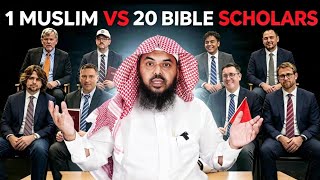 1:22:10
20 Christians vs 1 Muslim — Uthman ibn Farooq at Southern Baptist Theological Seminary
A structured debate between Shaykh Uthman ibn Farooq and twenty students and professors from the Southern Baptist Theological Seminary — the largest Baptist Bible university in America — held in Louisville, Kentucky. The debate rotates through four prompts via a flag-vote elimination mechanism: (1) The Prophet Muhammad is clearly mentioned in the Bible; (2) Jesus is not God according to the Bible; (3) Jesus is a prophet and servant of God; and (4) the Bible is not 100% preserved. Participants include a Conservative Presbyterian, a Biblical Unitarian pastor, Catholic and non-denominational students, an Episcopalian, and others. Key arguments cover Song of Solomon 5:16 (Muhammadim), Isaiah 42 (Kedar, Sal'a, Mushallam), ego imai in Luke and John, divine omniscience and hypostatic union, Acts 3:13, Hebrews 2:7-9, the Johannine Comma, Mark 16:9-20, Matthew-Luke genealogy contradictions, and the manuscript and chain-of-transmission preservation of the Quran.
Debate Excerpts (3)
Individual points from debates discussing this topic
“What spiritual incentive framing opens the discussion before the philosophical case?”
Hijab opens with the ethic of ongoing reward: building a masjid and enabling worship, learning, and shahada generates continuing benefit after death through downstream good deeds done in that space. This frames Islam not only as a truth-claim system but as a civilization-building program with cumulative social and spiritual impact.
“Why did Shaykh Uthman challenge the Southern Baptist Theological Seminary?”
Shaykh Uthman ibn Farooq introduces himself from Louisville, Kentucky, in the South Bible Belt. He and his team came to the Southern Baptist Theological Seminary — the biggest Baptist Bible University in America — and challenged all professors and Bible scholars to a debate. Twenty of them accepted. The challenge is designed to demonstrate that the Islamic case for prophethood and biblical criticism can stand up to scrutiny from multiple opponents simultaneously.
“Does Islam have a proselytizing component? How does Islamic dawah differ from forced conversion?”
Mary asks whether Muslims actively try to convert people, given the history of Christian proselytizing. Uthman confirms: yes, in Islam we share the message — this is called dawah. But nobody can be forced to become Muslim. The Quran states: there is no compulsion in religion. Uthman gives the historical example: Muslims ruled India for many hundreds of years and ruled Spain (Al-Andalus) for centuries. During all of this time, Christians, Jews, and Hindus lived there freely under Islamic rule — because forced conversion is not permitted. This is in contrast to what happened during the Spanish Inquisition, where religious coercion was practiced. Islamic dawah is an invitation, not a compulsion.
Questions (11)
Did Buddhist scriptures predict the coming of Prophet Muhammad ﷺ?
Muslim scholars argue that the six criteria given for identifying the 'next Buddha' — as recorded in the Gospel of Buddha compiled by Paul Carus — match Prophet Muhammad ﷺ precisely on all six points: attaining supreme insight at night, looking exceedingly bright at enlightenment, dying a natural death, dying at night, looking bright before death, and ceasing to exist on earth after death. Important caveat: the text cited is a 19th-century Western compilation, not a classical canonical Buddhist scripture.
How can Islam be called the religion of peace when it was spread by the sword?
The claim that Islam was spread by the sword is historically false. The word 'Islam' itself comes from 'salaam' (peace). Historian De Lacy O'Leary called this 'one of the most fantastically absurd myths.' Muslims ruled Spain for 800 years without forced conversions, over 80% of India remained non-Muslim after centuries of Muslim rule, and Indonesia — the world's largest Muslim country — was never invaded by a Muslim army.
What are the main objections critics raise against Muhammad ﷺ being in the Bible, and how do Muslims respond?
Critics raise four primary objections: (1) Deuteronomy 18 requires the prophet to come from among the Israelites, not Arabs; (2) John 14's Paraclete refers to the Holy Spirit, not a human prophet; (3) Song of Solomon's 'machmedim' is romantic poetry, not a prophecy; (4) 'Paran' in Deuteronomy 33 is Sinai, not Arabia. A fifth meta-objection is the 'awkward silence' — no pre-Islamic Jewish or Christian scholar documented these texts as pointing to Muhammad ﷺ. Each objection has a substantive Muslim response.
What does the Bhavishya Purana say about Prophet Muhammad ﷺ?
The Bhavishya Purana — one of Hinduism's 18 major Puranas — contains a passage that Muslim scholars argue explicitly names 'Muhammad' and describes his followers with seven characteristics that match Islamic practice precisely: circumcision, no topknot on the head, keeping beards, announcing the Adhan (call to prayer), eating all lawful food except pork, striving in God's path, and being known as Muslims. Note: The age and authenticity of this specific passage are disputed among scholars.
What do the Bible and the Qur'an agree on?
Far more than most people realise. The Bible and the Qur'an both declare that God is absolutely one (Deuteronomy 6:4; Mark 12:29; Qur'an 112:1), both command sincere private prayer (Matthew 6:5-6; Qur'an 2:45), both record fasting as an act of worship (Matthew 4:2; Joel 2:12; Qur'an 2:183), both prohibit pork (Leviticus 11:7-8; Qur'an 2:173) and intoxicants (Proverbs 20:1; Qur'an 5:90), both call for modesty in dress (1 Timothy 2:9; Qur'an 24:31), and both foreground care for orphans and the poor as markers of authentic faith (James 1:27; Qur'an 2:177). Even Jesus' posture in prayer — falling on his face (Matthew 26:39) — is the same prostration performed by every Muslim five times daily.
What is Original Sin, and does Islam reject it?
Original Sin is the Christian doctrine — most fully developed by Augustine in the 4th century CE — that Adam's transgression in the Garden of Eden passed a state of inherited guilt and moral corruption to every human being, requiring Christ's atoning sacrifice for redemption. Islam firmly rejects this, teaching instead that every human is born in a state of pure fitrah (natural purity), that no soul can bear the sin of another, and that God forgives through sincere repentance alone — without any blood sacrifice. The Hebrew Bible's own prophets — Ezekiel, Jeremiah, Isaiah, and Micah — all explicitly affirm individual accountability and deny that children bear the guilt of their parents.
What is the best form of Jihad in Islam?
The best form of Jihad varies according to circumstances. The Prophet Muhammad ﷺ described multiple forms: performing Hajj properly, serving one's parents, speaking a word of truth before an unjust ruler, and striving against one's own evil inclinations. In today's context, conveying the message of Islam peacefully (Da'wah) and correcting misconceptions is arguably the most important form of Jihad.
Why are most of the Muslims fundamentalists?
A 'fundamentalist' is simply someone who follows the fundamentals of their field. A doctor who follows medical fundamentals is a good doctor. A Muslim who follows the fundamentals of Islam — peace, justice, honesty, charity — is likewise a good Muslim. The negative connotation was artificially attached to the word by Western media.
Why does Islam allow Muslims to kill others in the name of Jihad?
Jihad does not mean 'holy war.' The Arabic word comes from 'jahada,' meaning to strive and struggle — against one's own evil inclinations, to improve society, to fight oppression, and to defend oneself. Fighting in battle (qitaal) is only one category of jihad, and is permitted only in self-defense. Killing any innocent human being is explicitly prohibited in the Qur'an.
Why does the media portray Islam negatively?
Between 1800 and 1950 alone, over 60,000 books were written against Islam — more than one per day. The media applies double standards: a Muslim woman in hijab is 'oppressed' while a Christian nun in similar dress is 'pious'; a Sikh in a turban is 'proud of his identity' while a Muslim with a beard and cap is labeled a 'fanatic.' For the media, turning black into white, or a hero into a villain, requires nothing more than framing.
Why should someone consider Islam?
Islam offers a direct, personal relationship with the Creator without any intermediaries; a clear, evidence-based faith supported by the preserved Qur'an; a practical and balanced way of life covering spiritual, social, and personal well-being; and a universal, timeless message — the same core monotheistic message brought by all Prophets throughout history.
Articles (8)
Common Ground: Bible Teachings That Align with the Qur'an and Islamic Practice
From monotheism to fasting, modesty to caring for orphans — the parallels between the Qur'an and the Bible are more extensive than most people realise.
TheOpenQuran Research
One of the most effective approaches in interfaith dialogue is to build on shared foundations. Muslims and Christians — and Muslims and Jews — share far more in common than their differences suggest. This article explores specific Bible verses that directly parallel Quranic teachings: the same insistence on one God, the same call to sincere private prayer, the same practice of fasting, the same prohibition of pork and alcohol, the same call to modesty, the same emphasis on caring for orphans and the poor. The Bible does not merely tolerate these Islamic practices — it commands them.
Did Jesus Die for Our Sins? A Biblical and Qur'anic Response
Examining the doctrine of atonement — what the Bible actually says about sin, sacrifice, and forgiveness
Sheikh Ahmad Deedat
The doctrine of atonement — that Jesus died to pay for humanity's inherited sin — is the cornerstone of mainstream Christianity. Yet the Bible itself, in its most direct prophetic statements, teaches the opposite: that sin is personal and non-transferable, that God does not require blood sacrifice to forgive, and that the path to salvation is repentance and righteous action. This article examines the doctrine of Original Sin and its foundation in the sacrifice narrative, the Islamic understanding of Jesus as 'Word of God' and 'Spirit from God,' and what Luke 24 reveals when Jesus himself corrects the misconception that he is a resurrected spiritual being.
How the Bible Was Changed: Verse-by-Verse Manuscript Evidence
What happens when you compare the King James Bible against the oldest surviving manuscripts of the New Testament?
TheOpenQuran Research
Every major modern Bible translation (NIV, ESV, NASB, RSV) contains footnotes where editors acknowledge that certain verses — including some of the most theologically significant — are 'absent from the earliest and most reliable manuscripts.' This article examines the most significant of those cases: specific verses where the text was demonstrably added, altered, or removed between the oldest surviving manuscripts and later copies. This is not a fringe Islamic claim — it is the consensus of mainstream Christian biblical scholarship, including conservative evangelical scholars like Bruce Metzger and F.F. Bruce. The Islamic concept of tahrif (textual alteration) is precisely what modern textual criticism confirms.
Jesus in His Own Words: Bible Verses That Challenge the Claim of Divinity
A systematic look at what the Bible records Jesus saying about himself, God, and the limits of his knowledge and power.
TheOpenQuran Research
Muslims, Christians, and Jews all hold Jesus in esteem — but they disagree profoundly about his nature. This article does not rely on the Qur'an alone. It examines what the Bible itself records Jesus saying about God, about his own limitations, about his need to pray, and about his role as a sent messenger. The evidence — drawn from Matthew, Mark, Luke, John, Acts, Hebrews, and the epistles — presents a consistent portrait of a man who was subordinate to God, had limited knowledge, experienced human needs, and directed worship to the Father. This article presents that evidence systematically and acknowledges the Christian interpretive response at each point.
15 Common Misconceptions About Islam — Addressed and Clarified
A comprehensive response to the most widespread myths surrounding Islam, Muslims, and the Qur'an
Compiled from Islamic Scholarship
From headlines linking Islam to extremism to centuries-old myths about the nature of Allah and the status of women, misconceptions about Islam are among the most pervasive in the modern world. This article systematically addresses fifteen of the most common misunderstandings — drawing from the Qur'an, the authenticated Sunnah, and the findings of non-Muslim historians and scholars — to offer a clear, evidence-based clarification for any sincere seeker of truth.
Prophet Muhammad ﷺ in the Bible, Torah, and World Scriptures: The Complete Evidence
How the Torah, Gospels, Hindu Vedas, and Buddhist scriptures all prophesied the final Messenger of God
TheOpenQuran Research
Is Muhammad ﷺ mentioned in the Bible, Torah, and world scriptures? Yes — and this is the complete evidence. From Deuteronomy 18:18 and Isaiah 42 to Song of Solomon's 'Muhammadim' in Hebrew, the Gospel of John's Comforter, the Hindu Bhavishya Purana naming him explicitly, the Vedas' Narasansha, and the Buddhist six-criteria prophecy — every major tradition points to one man.
Is Muhammad ﷺ Really in the Bible? The Evidence, the Objections, and the Answers
A rigorous examination of the Quranic claim, the textual evidence, and every major scholarly challenge
TheOpenQuran Research
The Quran explicitly claims that Prophet Muhammad ﷺ is described by name in the Torah and the Gospel, and that Jesus himself predicted him. Critics raise four major objections to the Muslim textual evidence. This article presents the strongest case for each objection — and then systematically answers each one using historical, linguistic, and logical analysis drawn from the work of Dr. Zakir Naik, comparative religion scholars, and the Quran itself.
Original Sin: What the Bible and Qur'an Actually Say
Does the Bible support the doctrine that all humans inherit Adam's guilt? The answer may surprise you.
TheOpenQuran Research
One of Christianity's most distinctive doctrines — Original Sin — holds that Adam's transgression in the Garden of Eden passed a state of inherent guilt and corruption to every human being, requiring Christ's sacrifice for redemption. This article examines that doctrine through two lenses: first, what the Qur'an teaches about human nature (fitrah and personal accountability); and second — crucially — what the Bible's own prophets say about inherited guilt, individual responsibility, and how God forgives. The biblical evidence against inherited sin is direct, extensive, and largely overlooked.