Scientific Miracles in the Holy Quran
From A Brief Illustrated Guide to Understanding Islam
The Quran, revealed over fourteen centuries ago, contains descriptions of natural phenomena that have only been confirmed by modern science. From human embryology to the structure of mountains, from the origin of the universe to the formation of clouds — the precision of these descriptions points to a source beyond human knowledge of the seventh century.
Introduction
The Quran is the literal word of God, revealed to the Prophet Muhammad (peace be upon him) through the Angel Gabriel. It was memorized by Muhammad, dictated to his Companions, written down, and reviewed in its entirety with the Angel Gabriel every year — twice in the final year of his life. From the time of its revelation until today, countless Muslims have memorized it cover to cover, letter by letter. Not a single word has changed in over fourteen centuries.
What makes the Quran remarkable as a historical document is not only its perfect preservation but its content. The Quran contains descriptions of the natural world — human development, geology, cosmology, oceanography, and meteorology — that align precisely with discoveries made only in the modern era, using advanced equipment and scientific methods that did not exist in seventh-century Arabia.
This article presents several of these descriptions, drawn from A Brief Illustrated Guide to Understanding Islam. It is beyond reason that any human being, fourteen hundred years ago, could have known these facts. The most reasonable conclusion, as many scientists have themselves acknowledged, is that the Quran is not a human composition — it is revelation from the Creator of the universe.
A) The Quran on Human Embryonic Development
In the Holy Quran, God describes the stages of human embryonic development with a precision that was not understood by science until the twentieth century.
وَلَقَدْ خَلَقْنَا الْإِنسَانَ مِن سُلَالَةٍ مِّن طِينٍ ثُمَّ جَعَلْنَاهُ نُطْفَةً فِي قَرَارٍ مَّكِينٍ ثُمَّ خَلَقْنَا النُّطْفَةَ عَلَقَةً فَخَلَقْنَا الْعَلَقَةَ مُضْغَةً
“We created man from an extract of clay. Then We made him as a drop in a place of settlement, firmly fixed. Then We made the drop into an alaqah (leech, suspended thing, and blood clot), then We made the alaqah into a mudghah (chewed substance)...”
The Arabic word alaqah carries three meanings: (1) leech, (2) suspended thing, and (3) blood clot. All three meanings correspond precisely to the appearance and behavior of the human embryo at this stage of development.
In comparing a leech to an embryo in the alaqah stage, there is a remarkable similarity in appearance. Moreover, the embryo at this stage obtains nourishment from the blood of the mother, just as a leech feeds on the blood of others.
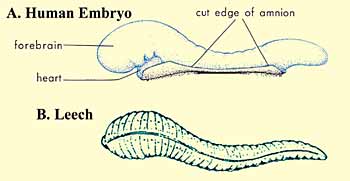
Drawings illustrating the similarities in appearance between a leech and a human embryo at the alaqah stage.
Leech drawing from Human Development as Described in the Quran and Sunnah, Moore and others, p. 37. Embryo drawing from The Developing Human, Moore and Persaud, 5th ed., p. 73.
The second meaning — 'suspended thing' — describes exactly how the embryo is suspended in the womb of the mother during this stage, attached by the connecting stalk.
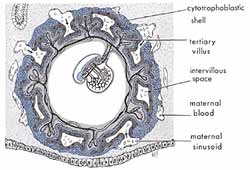
Diagram showing the suspension of an embryo during the alaqah stage in the uterus of the mother.
The Developing Human, Moore and Persaud, 5th ed., p. 66.
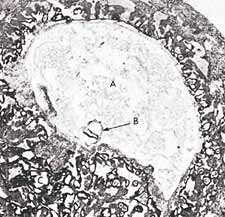
Photomicrograph showing the suspension of an embryo (marked B) during the alaqah stage (about 15 days old) in the womb of the mother. The actual size of the embryo is about 0.6 mm.
The Developing Human, Moore, 3rd ed., p. 66, from Histology, Leeson and Leeson.
The third meaning — 'blood clot' — is also accurate. The external appearance of the embryo and its sacs during this stage is similar to that of a blood clot, due to the relatively large amounts of blood present. The blood in the embryo does not circulate until the end of the third week, so at this point it genuinely resembles a clot of blood.
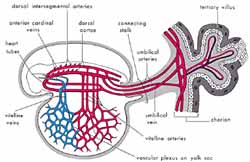
Diagram of the primitive cardiovascular system in an embryo during the alaqah stage. The external appearance of the embryo and its sacs is similar to a blood clot, due to the large amounts of blood present.
The Developing Human, Moore and Persaud, 5th ed., p. 65.
The next stage mentioned in the Quran is the mudghah — the Arabic word for 'chewed substance.' An embryo at this stage acquires the appearance of a chewed piece of gum, because the somites along the back of the embryo resemble the indentations left by teeth.
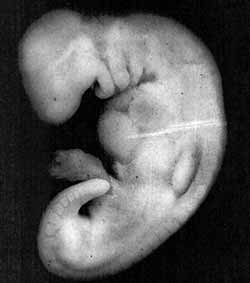
Photograph of an embryo at the mudghah stage (28 days old). The embryo at this stage acquires the appearance of a chewed substance, because the somites at the back of the embryo somewhat resemble teeth marks. Actual size: 4 mm.
The Developing Human, Moore and Persaud, 5th ed., p. 82, from Professor Hideo Nishimura, Kyoto University, Japan.
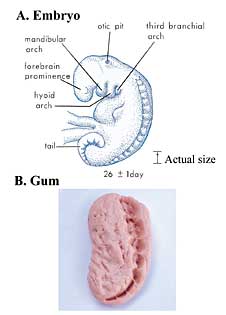
Comparison of an embryo at the mudghah stage with a piece of chewed gum, showing the similarity between the somites on the embryo's back and the indentations left by teeth.
The Developing Human, Moore and Persaud, 5th ed., p. 79.
How could Muhammad (peace be upon him) have known this fourteen hundred years ago, when scientists only discovered these details using microscopes and advanced equipment that did not exist in his time? Hamm and Leeuwenhoek were the first scientists to observe human sperm cells using an improved microscope in 1677 — more than a thousand years after Muhammad. They mistakenly thought that the sperm cell contained a miniature preformed human being that grew when deposited in the female genital tract.
“It has been a great pleasure for me to help clarify statements in the Quran about human development. It is clear to me that these statements must have come to Muhammad from God, because almost all of this knowledge was not discovered until many centuries later. This proves to me that Muhammad must have been a messenger of God.”
Professor Keith L. Moore
Professor Emeritus of Anatomy and Cell Biology, University of Toronto — author of The Developing Human, translated into eight languages
When asked whether this meant he believed the Quran to be the word of God, Professor Moore replied: 'I find no difficulty in accepting this.'
“Because the staging of human embryos is complex, owing to the continuous process of change during development, it is proposed that a new system of classification could be developed using the terms mentioned in the Quran and Sunnah. The proposed system is simple, comprehensive, and conforms with present embryological knowledge. The descriptions of the human embryo in the Quran cannot be based on scientific knowledge in the seventh century. The only reasonable conclusion is: these descriptions were revealed to Muhammad from God. He could not have known such details because he was an illiterate man with absolutely no scientific training.”
Professor Keith L. Moore
At a scientific conference, on classifying embryonic stages
B) The Quran on Mountains
A book entitled Earth, authored in part by Professor Emeritus Frank Press — former Science Advisor to US President Jimmy Carter and President of the National Academy of Sciences for twelve years — explains that mountains have deep roots beneath the surface. These roots are deeply embedded in the ground, thus mountains have a shape like a peg.
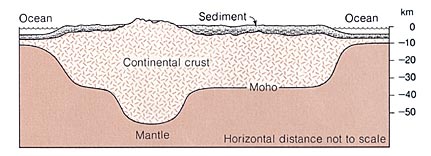
Mountains have deep roots under the surface of the ground.
Earth, Press and Siever, p. 413.
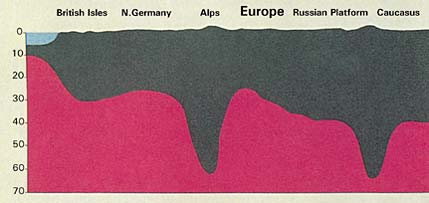
Schematic section. The mountains, like pegs, have deep roots embedded in the ground.
Anatomy of the Earth, Cailleux, p. 220.
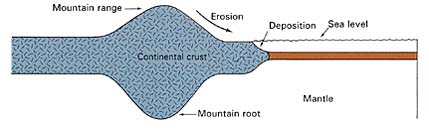
Another illustration shows how the mountains are peg-like in shape, due to their deep roots.
Earth Science, Tarbuck and Lutgens, p. 158.
This is precisely how the Quran described mountains over fourteen centuries ago:
أَلَمْ نَجْعَلِ الْأَرْضَ مِهَادًا وَالْجِبَالَ أَوْتَادًا
“Have We not made the earth as a bed, and the mountains as pegs?”
Modern earth sciences have proven that mountains have deep roots under the surface of the ground and that these roots can reach several times their elevations above the surface. So the most suitable word to describe mountains on the basis of this information is the word 'peg,' since most of a properly set peg is hidden under the surface of the ground. The theory of mountains having deep roots was not introduced until the latter half of the nineteenth century.
Mountains also play an important role in stabilizing the crust of the earth. They hinder the shaking of the earth. The Quran stated this fact as well:
وَأَلْقَىٰ فِي الْأَرْضِ رَوَاسِيَ أَن تَمِيدَ بِكُمْ
“And He has set firm mountains in the earth so that it would not shake with you...”
Likewise, the modern theory of plate tectonics holds that mountains work as stabilizers for the earth. This knowledge about the role of mountains as stabilizers for the earth has just begun to be understood in the framework of plate tectonics since the late 1960s. Could anyone during the time of the Prophet Muhammad have known of the true shape of mountains? Could anyone imagine that the solid massive mountain which he sees before him actually extends deep into the earth and has a root, as scientists assert?
C) The Quran on the Origin of the Universe
The science of modern cosmology, observational and theoretical, clearly indicates that at one point in time, the whole universe was nothing but a cloud of 'smoke' — an opaque highly dense and hot gaseous composition. This is one of the undisputed principles of standard modern cosmology. Scientists now can observe new stars forming out of the remnants of that 'smoke.'
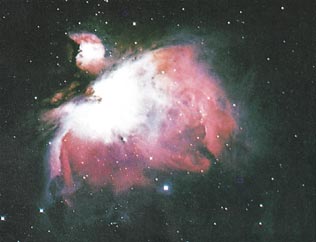
A new star forming out of a cloud of gas and dust (nebula), which is one of the remnants of the 'smoke' that was the origin of the whole universe.
The Space Atlas, Heather and Henbest, p. 50.
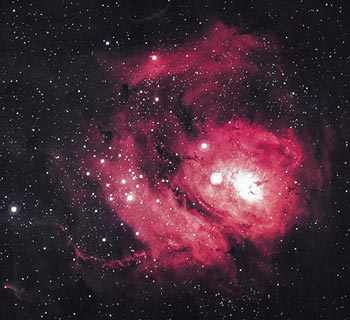
The Lagoon nebula is a cloud of gas and dust, about 60 light years in diameter. It is excited by the ultraviolet radiation of the hot stars that have recently formed within its bulk.
Horizons, Exploring the Universe, Seeds, plate 9, from Association of Universities for Research in Astronomy, Inc.
The illuminating stars we see at night were, just as was the whole universe, in that 'smoke' material. God has said in the Quran:
ثُمَّ اسْتَوَىٰ إِلَى السَّمَاءِ وَهِيَ دُخَانٌ
“Then He turned to the heaven when it was smoke...”
Because the earth and the heavens above (the sun, the moon, stars, planets, galaxies, etc.) have been formed from this same 'smoke,' we conclude that the earth and the heavens were one connected entity. Then out of this homogeneous 'smoke,' they formed and separated from each other. God has said in the Quran:
أَوَلَمْ يَرَ الَّذِينَ كَفَرُوا أَنَّ السَّمَاوَاتِ وَالْأَرْضَ كَانَتَا رَتْقًا فَفَتَقْنَاهُمَا
“Have not those who disbelieved known that the heavens and the earth were one connected entity, then We separated them?...”
Furthermore, the Quran describes the ongoing expansion of the universe:
وَالسَّمَاءَ بَنَيْنَاهَا بِأَيْدٍ وَإِنَّا لَمُوسِعُونَ
“And the heaven We constructed with strength, and indeed, We are [its] expander.”
The expansion of the universe is one of the most important discoveries of modern science. It was first suggested by the general theory of relativity and confirmed observationally by Edwin Hubble in 1929.
“Thinking where Muhammad came from... I think it is almost impossible that he could have known about things like the common origin of the universe, because scientists have only found out within the last few years, with very complicated and advanced technological methods, that this is the case.”
Dr. Alfred Kroner
Professor of Geology and Chairman of the Department of Geology, Institute of Geosciences, Johannes Gutenberg University, Mainz, Germany
“Somebody who did not know something about nuclear physics fourteen hundred years ago could not, I think, be in a position to find out from his own mind, for instance, that the earth and the heavens had the same origin.”
Dr. Alfred Kroner
On the impossibility of seventh-century knowledge of cosmology
D) The Quran on the Cerebrum
God said in the Quran about one of the evil unbelievers who forbade the Prophet Muhammad from praying at the Kaaba:
كَلَّا لَئِن لَّمْ يَنتَهِ لَنَسْفَعًا بِالنَّاصِيَةِ نَاصِيَةٍ كَاذِبَةٍ خَاطِئَةٍ
“No! If he does not desist, We will surely drag him by the nasiyah (front of the head) — a lying, sinful nasiyah!”
Why did the Quran describe the front of the head as being lying and sinful? Why didn't the Quran say that the person was lying and sinful? What is the relationship between the front of the head and lying and sinfulness?
If we look into the skull at the front of the head, we will find the prefrontal area of the cerebrum. What does physiology tell us about the function of this area?
A book entitled Essentials of Anatomy & Physiology says about this area: 'The motivation and the foresight to plan and initiate movements occur in the anterior portion of the frontal lobes, the prefrontal area. This is a region of association cortex...' The book also states: 'In relation to its involvement in motivation, the prefrontal area is also thought to be the functional center for aggression....'
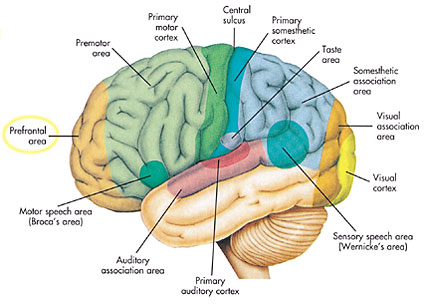
Functional regions of the left hemisphere of the cerebral cortex. The prefrontal area is located at the front of the cerebral cortex. It is responsible for planning, motivation, and the initiation of behavior — both good and sinful.
Essentials of Anatomy & Physiology, Seeley and others, p. 210.
So, this area of the cerebrum is responsible for planning, motivating, and initiating good and sinful behavior and is responsible for the telling of lies and the speaking of truth. Thus, it is proper to describe the front of the head as lying and sinful when someone lies or commits a sin, as the Quran has said: '...A lying, sinful nasiyah (front of the head)!'
Scientists have only discovered these functions of the prefrontal area in the last sixty years, according to Professor Keith L. Moore.
E) The Quran on Seas and Rivers
Modern science has discovered that in the places where two different seas meet, there is a barrier between them. This barrier divides the two seas so that each sea has its own temperature, salinity, and density. For example, Mediterranean sea water is warm, saline, and less dense, compared to Atlantic ocean water. When Mediterranean sea water enters the Atlantic over the Gibraltar sill, it moves several hundred kilometers into the Atlantic at a depth of about 1,000 meters with its own warm, saline, and less dense characteristics. The Mediterranean water stabilizes at this depth.
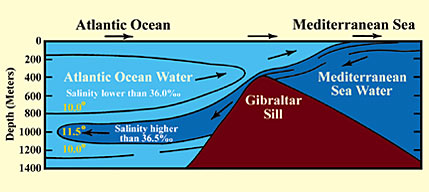
The Mediterranean sea water as it enters the Atlantic over the Gibraltar sill with its own warm, saline, and less dense characteristics, because of the barrier that distinguishes between them. Temperatures are in degrees Celsius (C°).
Marine Geology, Kuenen, p. 43, with a slight enhancement.
Although there are large waves, strong currents, and tides in these seas, they do not mix or transgress this barrier. The Holy Quran mentioned that there is a barrier between two seas that meet and that they do not transgress:
مَرَجَ الْبَحْرَيْنِ يَلْتَقِيَانِ بَيْنَهُمَا بَرْزَخٌ لَّا يَبْغِيَانِ
“He has set free the two seas meeting together. There is a barrier between them. They do not transgress.”
But when the Quran speaks about the divider between fresh and salt water, it mentions the existence of 'a forbidding partition' with the barrier:
وَهُوَ الَّذِي مَرَجَ الْبَحْرَيْنِ هَٰذَا عَذْبٌ فُرَاتٌ وَهَٰذَا مِلْحٌ أُجَاجٌ وَجَعَلَ بَيْنَهُمَا بَرْزَخًا وَحِجْرًا مَّحْجُورًا
“He is the one who has set free the two kinds of water, one sweet and palatable, and the other salty and bitter. And He has made between them a barrier and a forbidding partition.”
One may ask, why did the Quran mention the partition when speaking about the divider between fresh and salt water, but did not mention it when speaking about the divider between the two seas?
Modern science has discovered that in estuaries, where fresh (sweet) and salt water meet, the situation is somewhat different from what is found in places where two seas meet. It has been discovered that what distinguishes fresh water from salt water in estuaries is a 'pycnocline zone with a marked density discontinuity separating the two layers.' This partition (zone of separation) has a different salinity from the fresh water and from the salt water.
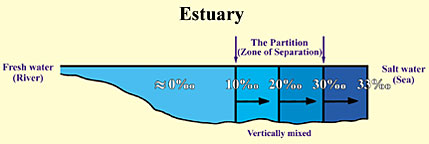
Longitudinal section showing salinity (parts per thousand ‰) in an estuary. We can see here the partition (zone of separation) between the fresh and the salt water.
Introductory Oceanography, Thurman, p. 301, with a slight enhancement.
This information has been discovered only recently, using advanced equipment to measure temperature, salinity, density, oxygen dissolubility, etc. The human eye cannot see the difference between the two seas that meet, rather the two seas appear to us as one homogeneous sea. Likewise, the human eye cannot see the division of water in estuaries into the three kinds: fresh water, salt water, and the partition (zone of separation).
F) The Quran on Deep Seas and Internal Waves
God has said in the Quran:
أَوْ كَظُلُمَاتٍ فِي بَحْرٍ لُّجِّيٍّ يَغْشَاهُ مَوْجٌ مِّن فَوْقِهِ مَوْجٌ مِّن فَوْقِهِ سَحَابٌ ۚ ظُلُمَاتٌ بَعْضُهَا فَوْقَ بَعْضٍ
“Or (the unbelievers' state) is like the darkness in a deep sea. It is covered by waves, above which are waves, above which are clouds. Darknesses, one above another. If a man stretches out his hand, he cannot see it...”
This verse mentions the darkness found in deep seas and oceans, where if a man stretches out his hand, he cannot see it. The darkness in deep seas and oceans is found around a depth of 200 meters and below. At this depth, there is almost no light. Below a depth of 1,000 meters there is no light at all. Human beings are not able to dive more than forty meters without the aid of submarines or special equipment.
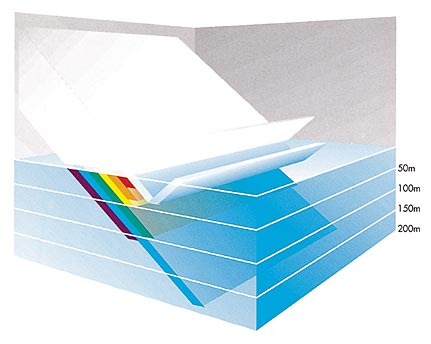
Between 3 and 30 percent of the sunlight is reflected at the sea surface. Then almost all of the seven colors of the light spectrum are absorbed one after another in the first 200 meters, except the blue light.
Oceans, Elder and Pernetta, p. 27.
Scientists have recently discovered this darkness by means of special equipment and submarines that have enabled them to dive into the depths of the oceans.
We can also understand from the verse that the deep waters of seas and oceans are covered by waves, and above these waves are other waves. It is clear that the second set of waves are the surface waves that we see, because the verse mentions that above the second waves there are clouds. But what about the first waves?
Scientists have recently discovered that there are internal waves which 'occur on density interfaces between layers of different densities.' The internal waves cover the deep waters of seas and oceans because the deep waters have a higher density than the waters above them. Internal waves act like surface waves. They can also break, just like surface waves. Internal waves cannot be seen by the human eye, but they can be detected by studying temperature or salinity changes at a given location.
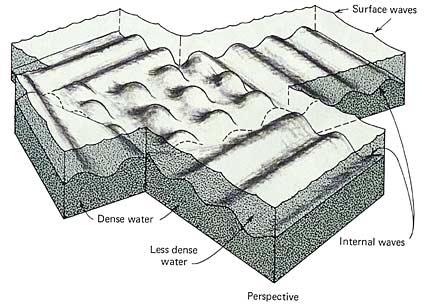
Internal waves at the interface between two layers of water of different densities. One is dense (the lower one), the other one is less dense (the upper one).
Oceanography, Gross, p. 204.
These facts about deep sea darkness and internal waves were not known in the seventh century. Even sailors of that era could not have dived deep enough to observe these phenomena. How then could an illiterate man in the Arabian desert have described them with such accuracy?
G) The Quran on Clouds
Scientists have studied cloud types and have realized that rain clouds are formed and shaped according to definite systems and certain steps connected with certain types of wind and clouds.
One kind of rain cloud is the cumulonimbus cloud. Meteorologists have studied how cumulonimbus clouds are formed and how they produce rain, hail, and lightning. They have found that cumulonimbus clouds go through the following steps to produce rain:
1) The clouds are pushed by the wind
Cumulonimbus clouds begin to form when wind pushes some small pieces of clouds (cumulus clouds) to an area where these clouds converge.
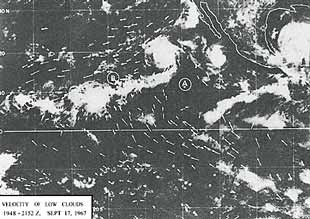
Satellite photo showing the clouds moving towards the convergence areas B, C, and D. The arrows indicate the directions of the wind.
The Use of Satellite Pictures in Weather Analysis and Forecasting, Anderson and others, p. 188.
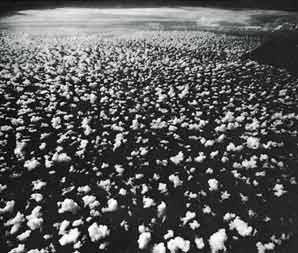
Small pieces of clouds (cumulus clouds) moving towards a convergence zone near the horizon, where we can see a large cumulonimbus cloud.
Clouds and Storms, Ludlam, plate 7.4.
2) Joining
Then the small clouds join together forming a larger cloud.
3) Stacking
When the small clouds join together, updrafts within the larger cloud increase. The updrafts near the center of the cloud are stronger than those near the edges. These updrafts cause the cloud body to grow vertically, so the cloud is stacked up. This vertical growth causes the cloud body to stretch into cooler regions of the atmosphere, where drops of water and hail formulate and begin to grow larger and larger. When these drops of water and hail become too heavy for the updrafts to support them, they begin to fall from the cloud as rain, hail, etc.
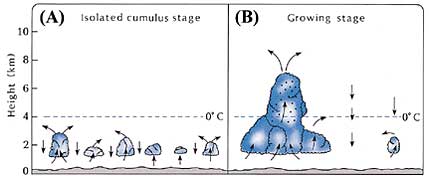
(A) Isolated small pieces of clouds (cumulus clouds). (B) When the small clouds join together, updrafts within the larger cloud increase, so the cloud is stacked up. Water drops are indicated by ·.
The Atmosphere, Anthes and others, p. 269.
A cumulonimbus cloud. After the cloud is stacked up, rain comes out of it.
Weather and Climate, Bodin, p. 123.
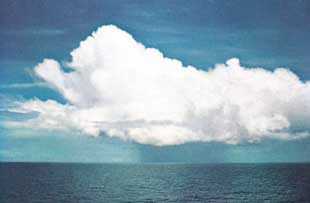
A cumulonimbus cloud.
A Colour Guide to Clouds, Scorer and Wexler, p. 23.
God has said in the Quran:
أَلَمْ تَرَ أَنَّ اللَّهَ يُزْجِي سَحَابًا ثُمَّ يُؤَلِّفُ بَيْنَهُ ثُمَّ يَجْعَلُهُ رُكَامًا فَتَرَى الْوَدْقَ يَخْرُجُ مِنْ خِلَالِهِ
“Have you not seen how God makes the clouds move gently, then joins them together, then makes them into a stack, and then you see the rain come out of it....”
Meteorologists have only recently come to know these details of cloud formation, structure, and function by using advanced equipment like planes, satellites, computers, balloons, and other equipment, to study wind and its direction, to measure humidity and its variations, and to determine the levels and variations of atmospheric pressure.
The preceding verse, after mentioning clouds and rain, speaks about hail and lightning:
وَيُنَزِّلُ مِنَ السَّمَاءِ مِن جِبَالٍ فِيهَا مِن بَرَدٍ فَيُصِيبُ بِهِ مَن يَشَاءُ وَيَصْرِفُهُ عَن مَّن يَشَاءُ ۖ يَكَادُ سَنَا بَرْقِهِ يَذْهَبُ بِالْأَبْصَارِ
“...And He sends down hail from mountains (clouds) in the sky, and He strikes with it whomever He wills, and turns it from whomever He wills. The vivid flash of its lightning nearly blinds the sight.”
Meteorologists have found that these cumulonimbus clouds, that shower hail, reach a height of 25,000 to 30,000 ft (4.7 to 5.7 miles), like mountains, as the Quran said: '...And He sends down hail from mountains (clouds) in the sky...'
This verse may raise a question: Why does the verse say 'its lightning' in a reference to the hail? Does this mean that hail is the major factor in producing lightning? Let us see what the book Meteorology Today says about this.
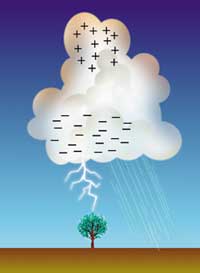
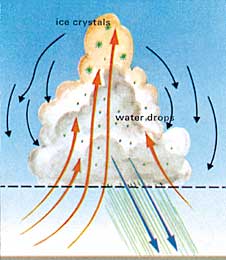
Diagram showing how lightning is produced by hail in cumulonimbus clouds. As liquid droplets collide with a hailstone, they freeze on contact and release latent heat. Electrons flow from the colder ice crystal toward the warmer hailstone, making it negatively charged. Positively charged ice splinters are carried upward by updrafts, while hail falls toward the bottom — creating the charge separation that discharges as lightning.
Meteorology Today, Ahrens, p. 437.
It says that a cloud becomes electrified as hail falls through a region in the cloud of supercooled droplets and ice crystals. As liquid droplets collide with a hailstone, they freeze on contact and release latent heat. This keeps the surface of the hailstone warmer than that of the surrounding ice crystals. When the hailstone comes in contact with an ice crystal, electrons flow from the colder object toward the warmer object. Hence, the hailstone becomes negatively charged. The same effect occurs when supercooled droplets come in contact with a hailstone and tiny splinters of positively charged ice break off. These lighter positively charged particles are then carried to the upper part of the cloud by updrafts. The hail, left with a negative charge, falls towards the bottom of the cloud, thus the lower part of the cloud becomes negatively charged. These negative charges are then discharged as lightning. We conclude from this that hail is the major factor in producing lightning.
This information on lightning was discovered recently. Until 1600 AD, Aristotle's ideas on meteorology were dominant. For example, he said that the atmosphere contains two kinds of exhalation, moist and dry. He also said that thunder is the sound of the collision of the dry exhalation with the neighboring clouds, and lightning is the inflaming and burning of the dry exhalation with a thin and faint fire. These are some of the ideas on meteorology that were dominant at the time of the Quran's revelation, fourteen centuries ago.
H) Scientists' Comments on the Scientific Miracles in the Holy Quran
The following are comments from scientists on the scientific miracles in the Holy Quran. All of these comments have been taken from the videotape entitled 'This is the Truth,' in which the scientists were recorded giving these statements.
1) Dr. T. V. N. Persaud
Dr. T. V. N. Persaud is Professor of Anatomy, Professor of Pediatrics and Child Health, and Professor of Obstetrics, Gynecology, and Reproductive Sciences at the University of Manitoba, Winnipeg, Manitoba, Canada. There, he was the Chairman of the Department of Anatomy for 16 years. He is the author or editor of 22 textbooks and has published over 181 scientific papers. In 1991, he received the most distinguished award presented in the field of anatomy in Canada, the J.C.B. Grant Award from the Canadian Association of Anatomists.
“The way it was explained to me is that Muhammad was a very ordinary man. He could not read, didn't know how to write. In fact, he was an illiterate. And we're talking about fourteen hundred years ago. You have someone illiterate making profound pronouncements and statements and that are amazingly accurate about scientific nature. And I personally can't see how this could be a mere chance. There are too many accuracies and, like Dr. Moore, I have no difficulty in my mind that this is a divine inspiration or revelation which led him to these statements.”
Dr. T. V. N. Persaud
Professor of Anatomy, Pediatrics, and Obstetrics — University of Manitoba, Canada
2) Dr. Joe Leigh Simpson
Dr. Joe Leigh Simpson is the Chairman of the Department of Obstetrics and Gynecology, Professor of Obstetrics and Gynecology, and Professor of Molecular and Human Genetics at the Baylor College of Medicine, Houston, Texas, USA. Formerly, he was Professor of Ob-Gyn and the Chairman of the Department of Ob-Gyn at the University of Tennessee. He was also the President of the American Fertility Society. He has received many awards, including the Association of Professors of Obstetrics and Gynecology Public Recognition Award in 1992.
Professor Simpson studied the following two sayings of the Prophet Muhammad (peace be upon him):
“In every one of you, all components of your creation are collected together in your mother's womb by forty days...”
“If forty-two nights have passed over the embryo, God sends an angel to it, who shapes it and creates its hearing, vision, skin, flesh, and bones...”
He studied these two sayings of the Prophet Muhammad extensively, noting that the first forty days constitute a clearly distinguishable stage of embryo-genesis. He was particularly impressed by the absolute precision and accuracy of those sayings.
“So that the two hadeeths (sayings of the Prophet Muhammad) that have been noted provide us with a specific time table for the main embryological development before forty days. Again, the point has been made repeatedly: these hadeeths could not have been obtained on the basis of the scientific knowledge that was available at the time of their writing.... It follows, I think, that not only there is no conflict between genetics and religion but, in fact, religion can guide science by adding revelation to some of the traditional scientific approaches, that there exist statements in the Quran shown centuries later to be valid, which support knowledge in the Quran having been derived from God.”
Dr. Joe Leigh Simpson
Chairman, Department of Obstetrics and Gynecology — Baylor College of Medicine, Houston, Texas
3) Dr. E. Marshall Johnson
Dr. E. Marshall Johnson is Professor Emeritus of Anatomy and Developmental Biology at Thomas Jefferson University, Philadelphia, Pennsylvania, USA. There, for 22 years he was Professor of Anatomy, the Chairman of the Department of Anatomy, and the Director of the Daniel Baugh Institute. He was also the President of the Teratology Society. He has authored more than 200 publications.
“Summary: The Quran describes not only the development of external form, but emphasizes also the internal stages, the stages inside the embryo, of its creation and development, emphasizing major events recognized by contemporary science.”
Dr. E. Marshall Johnson
Professor Emeritus of Anatomy and Developmental Biology — Thomas Jefferson University
“As a scientist, I can only deal with things which I can specifically see. I can understand embryology and developmental biology. I can understand the words that are translated to me from the Quran. As I gave the example before, if I were to transpose myself into that era, knowing what I knew today and describing things, I could not describe the things which were described. I see no evidence for the fact to refute the concept that this individual, Muhammad, had to be developing this information from some place. So I see nothing here in conflict with the concept that divine intervention was involved in what he was able to write.”
Dr. E. Marshall Johnson
On the origin of Quranic knowledge of embryology
4) Dr. William W. Hay
Dr. William W. Hay is a well-known marine scientist. He is Professor of Geological Sciences at the University of Colorado, Boulder, Colorado, USA. He was formerly the Dean of the Rosenstiel School of Marine and Atmospheric Science at the University of Miami, Florida.
“I find it very interesting that this sort of information is in the ancient scriptures of the Holy Quran, and I have no way of knowing where they would come from, but I think it is extremely interesting that they are there and that this work is going on to discover it, the meaning of some of the passages.”
Dr. William W. Hay
Professor of Geological Sciences — University of Colorado, Boulder
When asked about the source of the Quran, Dr. Hay replied: 'Well, I would think it must be the divine being.'
5) Dr. Gerald C. Goeringer
Dr. Gerald C. Goeringer is Course Director and Associate Professor of Medical Embryology at the Department of Cell Biology, School of Medicine, Georgetown University, Washington, DC, USA.
“In a relatively few aayahs (Quranic verses) is contained a rather comprehensive description of human development from the time of commingling of the gametes through organogenesis. No such distinct and complete record of human development, such as classification, terminology, and description, existed previously. In most, if not all, instances, this description antedates by many centuries the recording of the various stages of human embryonic and fetal development recorded in the traditional scientific literature.”
Dr. Gerald C. Goeringer
Associate Professor of Medical Embryology — Georgetown University, Washington, DC
6) Dr. Yoshihide Kozai
Dr. Yoshihide Kozai is Professor Emeritus at Tokyo University, Hongo, Tokyo, Japan, and was the Director of the National Astronomical Observatory, Mitaka, Tokyo, Japan.
“I am very much impressed by finding true astronomical facts in the Quran, and for us the modern astronomers have been studying very small pieces of the universe. We've concentrated our efforts for understanding of a very small part. Because by using telescopes, we can see only very few parts of the sky without thinking about the whole universe. So, by reading the Quran and by answering to the questions, I think I can find my future way for investigation of the universe.”
Dr. Yoshihide Kozai
Professor Emeritus, Tokyo University — former Director, National Astronomical Observatory, Japan
7) Professor Tejatat Tejasen
Professor Tejatat Tejasen is the Chairman of the Department of Anatomy at Chiang Mai University, Chiang Mai, Thailand. Previously, he was the Dean of the Faculty of Medicine at the same university.
“During the last three years, I became interested in the Quran.... From my study and what I have learned from this conference, I believe that everything that has been recorded in the Quran fourteen hundred years ago must be the truth, that can be proved by the scientific means. Since the Prophet Muhammad could neither read nor write, Muhammad must be a messenger who relayed this truth, which was revealed to him as an enlightenment by the one who is eligible as the creator. This creator must be God.”
Professor Tejatat Tejasen
Chairman, Department of Anatomy — Chiang Mai University, Thailand
Professor Tejasen then declared his faith with the words: 'La ilaha illa Allah, Muhammadur rasoolu Allah' — There is no god to worship except Allah (God), Muhammad is the Messenger of Allah (God). He stated: 'The most precious thing of all that I have gained by coming to this place is La ilaha illa Allah, Muhammadur rasoolu Allah, and to have become a Muslim.'
After all these examples of scientific miracles in the Holy Quran and all these scientists' comments, let us ask ourselves: Could it be a coincidence that all this recently discovered scientific information from different fields was mentioned in the Quran, which was revealed fourteen centuries ago? Could this Quran have been authored by Muhammad or by any other human being? The only possible answer is that this Quran must be the literal word of God, revealed by Him.
Conclusion
The examples presented here are only a sample. The Quran contains many more descriptions of the natural world that have been verified by modern science — from the water cycle to the protective function of the atmosphere, from the formation of iron to the relationship between mountains and earthquakes.
These are not vague poetic metaphors. They are specific, detailed descriptions of natural phenomena that no human being could have known fourteen hundred years ago. The Prophet Muhammad (peace be upon him) was an illiterate man who grew up in the desert of Arabia, far from centers of learning. He had no access to microscopes, submarines, telescopes, or any scientific instruments.
The only reasonable explanation — one that several prominent scientists have themselves affirmed — is that the Quran is not a human composition. It is revelation from the One who created the heavens and the earth, and everything within them.
سَنُرِيهِمْ آيَاتِنَا فِي الْآفَاقِ وَفِي أَنفُسِهِمْ حَتَّىٰ يَتَبَيَّنَ لَهُمْ أَنَّهُ الْحَقُّ
“We will show them Our signs in the horizons and within themselves until it becomes clear to them that it is the truth.”
Qur'anic References
“Then We made him as a drop in a place of settlement, firmly fixed.”
Read in Qur'an Reader →“Then We made the drop into an alaqah, then We made the alaqah into a mudghah...”
Read in Qur'an Reader →“And He has set firm mountains in the earth so that it would not shake with you...”
Read in Qur'an Reader →“Have not those who disbelieved known that the heavens and the earth were one connected entity, then We separated them?...”
Read in Qur'an Reader →“And the heaven We constructed with strength, and indeed, We are its expander.”
Read in Qur'an Reader →“No! If he does not desist, We will surely drag him by the nasiyah —”
Read in Qur'an Reader →“And it is He who has released the two seas, one fresh and sweet and one salty and bitter, and He placed between them a barrier and a prohibiting partition.”
Read in Qur'an Reader →“Or they are like darknesses within an unfathomable sea which is covered by waves, upon which are waves, upon which are clouds — darknesses, some of them upon others.”
Read in Qur'an Reader →“Do you not see that God drives clouds, then joins them together, then makes them into a mass, and you see the rain emerge from within it...”
Read in Qur'an Reader →Hadith References
“In every one of you, all components of your creation are collected together in your mother's womb by forty days...”
“In every one of you, all components of your creation are collected together in your mother's womb by forty days...”
“If forty-two nights have passed over the embryo, God sends an angel to it, who shapes it and creates its hearing, vision, skin, flesh, and bones...”
Source: Islam Guide